Monday, January 31, 2011

My first pinnacle summit: Tel Baila


250 ft of sheer basalt dykes on the edge of the Western Ghats. Breathtaking views and awesome landscapes that’s how I can describe Tel Baila.. Scaling Telbaila pinnacle is no mean task and it was my second pinnacle attempt.

It was a challenge not only for me but for the regulars as well who had done the pinnacle before. From Lonavala, Telbaila village is 36 kms away. (about 10 km ahead of Amby valley at the edge of the Western Ghats). From here one can see Korigadh on the way. As I understand from the villagers the area is too remote and there is only one ST Bus that plies to this place. The bus starts from Lonavala at around 12.30 pm in the afternoon. And in the morning there is a bus at around 7.30 am from the Telbaila village to Lonavala.

The group comprising of Zenosh, Ritzz, Sneha, Kinnari, Meenaz, myself, Mallik, KD and Jay Sheth set out from Mumbai at 6 am. We had no issues as we got to the village by Car. After unloading our sacks as well as equipment from the car we sorted the equipment and left back few things that were not required in the car.

We set out on the trek at about 10 am. The trek is a pleasant one and in 30 minutes one can reach the col of the two walls of Telbaila. The Left wall is called Telbaila Fort, where in the col a small temple with two water cistern exist. Both the water cisterns did not have drinkable water. We were well aware of this and therefore carried lot of water with us. Also we were confident that since the village is only 30 minutes away we could alwys go and get water from the village. The temple is well maintained by the local villagers. There’s a concretized plane that has been built by the villagers where trekkers and climbers can rest well. In the Fort wall there exists a cave which is where we decided to cook our night meals.

As per our plan we were to climb the first Col near the temple on Saturday and the next day we were to climb the tough route that’s the village route.

Equipment we carried:

We were carrying with us two 60 mts (10.3 mm) dynamic rope (One Edelwise. One Beal), One 8mm static rope (Todi) and one 100m rope. Apart from the ropes we had 25 quick draws, 15 carabiners, 8 belay device, 15 tapes and slings, 8 jumars (ascending device), helmets, harness and climbing shoes.
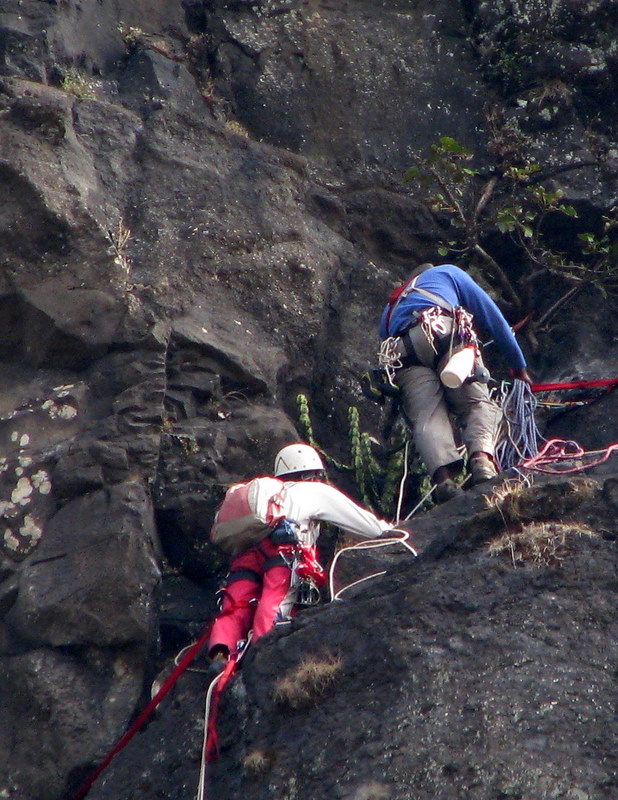
We started our climb form the temple side. There are bolts & pegs on the way for anchoring. Mallik took the lead & fixed the rope till the first ledge. He was followed by Zebnosh and the others followed one after the other.

By the time I reached the first ledge which was roughly at a height of around 100 feet, Zenosh had already started his lead climb to the summit. Within 20 minutes he summitted. Soon after Zen summitted the rest of us followed. By the time it was 5 we had all summitted and rappelled our way back to the temple. Zen was the last man to rappel down. By the time he came down, our Head cook Mallik was ready with some tea and had already started preparing for the three course dinner.

Next morning we were all up and ready for day two climb from the village route. While some of us stayed back to clear the place, the rest of the gang accompanied Ritzz and Zen for the climb. Ritzz led the climb upto the second leadge. The climb from the village route was a real challenging one. Sneha followed Ritzz and thereafter Zen, Jay and Meenaz followed. By this time I had given up and said I will not climb. But thanks to Meenaz, Farzin, Kinnari and Mallik who encouraged and motivated me. Not having climbed for so long I had no confidence and was not sure if I could climb. I was happy clicking everyone’s pictures at the base.

Then I was told I should climb up till the second ledge which is about 150 feet. So finally I decided yo! I am giving this a shot… but I had to remember the fact that once I stat climbing there is no option but to keep climbing till I reach the second ledge…there was no way I could climb down… I was prepared.

So I too climbed the vertical patch…the rock had excellent friction holds, cracks, pressure holds. I was glad I was getting some good grip..but yeah, the exposure on one side did get the adrenaline ticking faster..at one point I was right on top standing on my two feet with my index finger of my right hand in a finger hold and stretching out my left hand to get a good hand hold that Meenz was directing me to. At this point my legs were shaking..not due to fatigue, but I guess it was more out of fear of the sheer depth below…I finally managed to pull myself up and get on the first ledge where Meenaz was stationed to top belay. Phew.. the climb was indeed thrilling. With Meenaz belaying me I was also rest assured that I ain’t going to fall.

From this point I had a short traverse and then climb on to the second ledge where sneha, jay and Ritzz were stationed. This was a horrible stretch with lots of scree. I somehow managed and as soon as I got up there I self anchored myself, took stalk of my position and settled down in a narrow space. I knew I had to wait there for atleast next two to three hours before we rappell down. I wasn’t going to summit the village route.

The next three hours spent on the second ledge was awesome. I was literary on the cliff with the valley on one side, trees over on the plain before the valley… The only saving grace was the fact that we were in shade. As Ritzz, myself, Meenaz and KD waited at the ledge we heard that Zen had summitted successfully followed by Sneha and Jay. Everyone was elated. We were running out of time and we had a cut off time of 4 pm. It was already 3.30. So we decided we stop here and rappell down.

Unlike my first unnamed pinnacle climb this New Year’s weekend, this was a better climb. There was no climbing actually during the New Year’s climb. I actually did 250 feet of jumaring (ascending with a jumar device) which was a tiring task. Telbaila on the other hand was all about rock climbing. Infact I was told that its well known as the destination for beginners precisely because the rock is so good for gripping and holding. At the same time, there is a certain thrill factor involved because of the vertical nature of the climb … I personally had an excellent time climbing through the village route.

My confidence level has increased a bit now. I am also very thankful to Ritzz, Meenaz and the rest of the gang to take a novice like me on such a climb.

Wednesday, January 26, 2011

New Year's Virgin Pinnacle Climb! a great high


It was a new year well spent for me. I had the opportunity to partly scale a virgin pinnacle in the Trimbak region of Nashik. While it was a new beginning for me, for the Bhramanti Group of climbers from Mumbai it was a historic start of 2011. The 4 summitters- Kishor Chavan, Kaivalya, Suhas Shirke and Arun Sawant scaled their fourth virgin pinnacle on 2nd jan, 2011. The other three being Irshal crack, Sunday II virgin route and Bahuli III
It took them 3 full days to scale this 600 feet virgin pinnacle adding yet another feather to their cap. I can imagine the kind of adrenaline rush such a climb can give. For mountaineers and climbers anything that is out of the ordinary and challenging always gives a high. The other support members of the group were Tapan Vaidya, Prashant Sawant, Nitin Devedra, Dr. Narendra Patil, Ravi Bangera, Ritzz, Jay Seth, Meenaz Lala, Anusha (myself) and Sneha Sathe.
The Virgin Piannacle has been named “Rudra” by the Bhramantis, symbolizing hardship of climbing & an unexisting powerful entity. Rudra which is next to Anjneri fort is surrounded by other pinnacles such as Navra Navri, Hanuman, Sunday 1 and Sunday 2. So how was the experience of climbing a virgin pinnacle? Kishor, the lead climber says, “Absolutely challenging and exciting at the same time. We had to battle the cold winds and fixed 800 feet of rope to be able to summit the pinnacle.”
As per the Bhramantis, the virgin pinnacle climb happened by chance. It was not part of the group’s initial plan. The initial plan was to scale the Hanuman pinnacle. When the group reached Pahine, the base village they noticed this virgin pinnacle. When enquired with the villagers, they were told that was not Hanuman and did not know what it was called. The group was also informed that no other group had gone up this virgin pinnacle to climb it. That was enough to get the group excited. Not having the slightest clue of how the climb is likely to be, the group decided this is it and set out.
For Kishor it was the first virgin pinnacle that he was lead climbing. While he says he was a bit apprehensive he was also excited. “In a known pinnacle you are aware of the route and what is required. Moreover there is enough information available about the known pinnacle which you can gather from people who have climbed it before. That’s not the case in a virgin pinnacle you start on a new slate,” says Kishor.
Luckily the group was well equipped as the initial pinnacle Hanuman that they were to climb was a high grade pinnacle. The equipment was carried as per that pinnacle. The virgin pinnacle was attempted over a period of three days. On the first day (30th December) we started the climb at around 1.30 pm in the afternoon and finished by 5 pm before night fall. The first day we basically gauged the difficult and accordingly planned the climb and took the appropriate decisions.
On the second day (31st December’10) we started around 11 am and we stopped the climb at 5.30 pm. Third day we started around 9.30 am and around 3.35 pm I summited the pinnacle. The support team needed to be credited a great deal. If it was not for the support team the summit would not have been possible says Kishor.
It was a 600 feet vertical pinnacle but the route we fixed required more than 800 feet of rope. A group which is looking to attempt this pinnacle will require 3 coils of 100mt rope for the whole pinnacle. The first protection that Kishor had was at 100 ft and little above this point he fixed the first piton. I climbed further fising pitons and went a little more above and reached the first ledge. It was a good ledge to stay put. So the first day we stopped at the first ledge. Kishor was supported by a very strong climbing team that included Kaivalya Varma as the second climber, followed by Arun Sawant and Suhas Shirke.
On the second day Kishor jumared upto the first ledge and started the climb from there. We reached the second ledge and stopped here. The second ledge was at a height of about 250 feet. On the third day, the climbers started at around 9.30 am Kishor jumared till the second ledge and then started the climb once again from here. But he had a battle quite a few cactus growth on the way to be able to climb well.
After the four main climbers had reached quite a distance a decision was taken to let us amateurs climb as well till the second ledge. I was excited as it was my first ever pinnacle attempt. We did not climb but jumared the entire 250 stretch and then rappelled down.
On the third day the climbing team had kept a cut off time of 4 pm. As per the cut off time the climbing team had to stop the climb irrespective of whether they summit or no. It was decided that wherever the lead climber has reached if the clock ticks 4 he would return back from that point itself. But just as I got closer to the summit I could see the summit but it wasn’t easy to reach the summit. It was already 3.15 pm and we had really worked hard to get till there. So Kishor then finally decided that come what may he needs to summit in the next 45 minutes. Fortunately, for Kishor as he started his climb again he reached the summit within the next 15 minutes. It looked difficult but ended up being quite easy. Followng him Kaivalya, Arun Sawant and Suhas Shirke also summited by 4 pm. As they say all well that ends well
A little bit about the Bhramanti Group has been in existence for last couple of years and has been conducting several treks, cycling, rock climbing and mountaineering expeditions in the Sahyadris as well as in the Himalayas. Kailvalya was the group leader
The day finally ended for us at around 11.30 pm in the night. That’s when we reached the village. After reaching the village the biggest task the group had was to sort out the equipment. After having done that we finally left the village at around 1.30 am and I reached home early morning at around 7 am on January 2, 2011. It was indeed a great beginning of a New Year and a weekend well spent.

About Trimbakeshwar:

Now just a bit about Trimbakeshwar. It is a famous pilgrim place. Trimbakeshwar is also the origin of river Godavari. Trimbakeshwar is one of the 12 jyotirlingas (and the eighth one in the series) of Lord Shiva and this one is considered to be the main jyotirlinga. Monday is a scared day here and Shivratri the holy day of Shiva Puja in a year is celebrated here. The Goddess in this temple is called Trimbakeshwari. This temple was constructed by Raju Balaji Baji Rao who ruled Maharashtra. Very near to the temple, Papaharini Theertam is located. People take bath here before visiting the temple which is considered as a holy bath. This place is formed by river Godavari after falling from Brahmagiri. The Temple premesis is called Brahmagiri, also considered as the most sacred place of river Godavari (Brahma Sthalam).

Sunday, October 10, 2010


My NIM experience: My first ascent to Rudugaira Peak (5819 mts)

It’s been three months since I have come back from the Himalaya’s after my Advance course. But, I still like to remember those days as often as I can and feel good. I had not written down anything on my experience as yet until recently, when I remembered my days at NIM (Nehru Institute of Uttarkashi) again. I had just received my Advance Course certificate. Felt good reading it.
My certificate reads: Excellent Leadership Qualities and Team Work and is recommended for High Altitude Mountaineering expeditions and Alpine Camps. Thanks to my instructors for believing in me.
I should tell you a little about Uttarkashi. Uttarkashi (district) in Uttarakhand state is at an altitude of 4000 mts. The streets though are a maze of cobbled lanes. It will take a while before you familiarize yourself to this small town and its lanes. The houses painted in variety of warm hues from Ocher to pinks and cheer Blues make up for quite a palette. If you stand at a height and look at the township you can gaze at an amazingly medley of houses in colours that seem to glow in the warm sunshine. It’s a lovely sight. There is an absolute rainbow of hues, interspersed with lush greenery. The charm of Uttarkashi lies in its people and their hospitality, the small lanes and its busy market. A walk through these narrow lanes in the bazaar is a must. No wonder that I love the place and would like to visit it as often as I could.

My intention to do the NIM course was not for grades but to learn and learn in harsh conditions. The course both Basic and Advance teaches you to deal with harsh environmental conditions, how to work calmly with a team on high altitudes, communicate better in difficult scenarios, be disciplined, have control on your temperament and be mentally strong. These learning I would say have helped in my daily course of life and my professional life too.

The Advance course is tougher than the Basic course in terms of learning new techniques, carrying more loads, preparing an expedition plan etc. Moreover, the advance course students are expected to be role models for the junior Basic Course students. So you are constantly being watched. Your behaviour is under scanner right from day one. Here is a little tip on writing an expedition plan...For expedition planning it is very important that one must pay attention in every lecture and take notes. Also one must start writing a plan during the course unlike me who had left most of the plan to be written on the last day after reaching the hostel. I had to spend a whole sleepless night to write a good plan.

There are few things that are different at the advance course. Unlike in the Basic course, in advance the trainees are put up in camps at Tekhla rocks for advance rock climbing. We pitch our own tents and camp in Tekhla for four days.
Once back at the institute we have artificial climbing sessions, lectures and checking of all equipment and gear before heading to the mountains.

This time around we were taken to Gangotri Glacier instead of Dhokrani Bhamak Glacier. Gangotri is a holy place. It is the origin of the river Ganga and seat of the goddess Ganga and is one of the four sites in the Char Dham pilgrimage circuit. Here you find tourists, pilgrims and mountaineers (Indian and Foreigners). This small town is centered around a temple of the goddess Ganga , which was built by the Napalese General, Amar Singh Thapa in the early 18th century. A visit to the temple and the market is a must here. It’s extremely colourful and the roadside restaurants are most often packed during the evenings, thanks to the tourists and the mountaineers.

The course was a daunting task. Steep ascent with 20 kg load on your back, walking on moraines and avalanche prone areas is no mean task. Our first long trek in to the mountains was really long. This started at Gangotri (Camp 1 at 3080 mts) to Nalla Camp (Intermediate camp) which was at 4280 mts- a height gain of straight 1200 mts… that was a huge. Many were tired and frustrated..some even snapped at each other... its natural..but in mountaineering this is what you are not supposed to do and control your temperament. While some of us were slow and were able to do it, most found it difficult. Many fell ill as soon as they reached the campsite. Reason: they were not well acclimatized and got acute Mountain sickness (AMS). Some even got high altitude pulmonary oedema HAPO).

The place was however beautiful. We could see Jogin peak from our camp site and it had a beautiful scenic surrounding. We were at this intermediate camp for two days due to heavy snow fall. We witnessed upto 2 feet of snow on the first night at the intermediate camp. The snow fall practically kept us awake the whole night as we took turns to shed off the snow from our tents. Lest it wet our tents. The porters and our instructors were also helping us in this task.

After two whole days at the intermediate camp, the third day we proceeded to the base camp at (4600 mts). This was also a beautiful picturesque place surrounded by peaks like the Gangotri Massif (Gangotri 1, 2 and 3) and Rudugaira. The trek to the Base Camp wasn't so bad.

While at the Base Camp we were trained on the Glacier and Snow. Training on the glacier wall involved revision of basic techniques, aid climbing, two piton base climbing, tip toe climbing and climbing using double ice axe.
Snow craft included Toe kicking, Side stepping, heel kicking; Glissading; Different types of belaying; Ice axe retrieval; Crevasse crossing; Rescue techniques in crevasse using C pulley and Z pulley; detecting avalanche prone area; lecture on avalanche rescue using a revolutionary system called Tracker Digital Transceiving System (DTS).

Just to explain what is DTS? It is designed to simplify multiple burial situations. Once a signal is found, the Tracker directs the searcher to that signal. If a second transmitter is detected during the search, the Tracker stays on course and continues to guide the user toward the strongest signal. Once the first victim is located and uncovered, the transmitting beacon should be switched off and the search for the next buried individual should begin.

After all the training and taking into account the weather conditions it was decided by our senior instructors that instead of summiting Gangotri-III (6577 mts) we would be sumitting RuduGaira peak (5819 mts). They decided against Gangotri III due to bad weather conditions. Infact even Rudugaira was a big ? but instructirs decided we would trek to the advance base camp and then decide the future course of action.

So day 14 of our training we got ready early to march to the advance base camp (4920 mts). Although the load we were carrying was less the trek was tough. We encountered steep walks, moraines and bad weather to add to it. But finally when we reached our camp site all the tiredness was forgotten. The best part was that the tents were already pitched. Amidst cold wind and bad weather it was extremely soothing sitting inside the kitchen tent and having hot cups of tea and snacks along with all the instructors. After a while we went for an acclimatisation walk which was good. The best part was that all the 19 of us were well acclamatised and raring to go. We couldn't resist the thought of summitting RuduGaira.

Once back at the camp site, each team had to cook their own meal for the night. We were given Maggie packets and few other ingredients that we wanted along with the gas burner and utensils. This was part of our training to cook in the high altitudes.

As I sat outside the tent to cook the Maggie along with my tent mates Indira and Maj Geetanjali, we had a lovely panoramic view of the mountains Manda1, 2, Brighupanth, Jogin on one side and on the other side; we could see the Gangotri massif. It was sunset time and we could see the tip of the peak shining gold. We finished dinner by 7 and were all ready to hit the sack. The next day was a big day for us –‘The Summit Day’ -The summit of Rudragaira peak(..5819 M) ;

The first group headed out at 4 am to open the route. The second group left half hour later. The weather was good but windy. The temperature was sub zero with 2 to 5 feet of snow. I wore 6 layers of clothing – 2 T shirts, 1 light jacket; 1 feather jacket and a wind proof jacket and windproof trouser with gaiters, snow boots, helmet and all technical equipment including ice axe and rope.
I maintained a steady pace all through but walked towards end. It was a steep walk all through and the weather was on our side. But we could not delay and had to summit by 9 as the heat was getting harsh. Once the snow starts getting loose it would be a tough for us to descend.

The first batch summitted almost an hour before the second batch. Nevertheless a few of us kept each other motivated and we all finally made it. Except three girls who mentally gave up towards the end. It was our first all woman Ascent to Rudugaira on June 17, 2010. It was a great sense of achievement for all of us. We spent hardly 2 minutes on the top of the peak and had to immediately start descending.

The descend was killing. After a while we had to put on our crampons as the snow got loose and it was difficult getting a grip to walk down.

But as they say all’ well that end’s well. Each and everyone reached the advance camp safely.

The course has helped me hone my technical skills but as they say no amount of training helps unless and until you continuously practice it. The expedition was one hell of an experience. After you have experienced it, you realize what it takes to be a mountaineer.

Wednesday, May 26, 2010

Back at NIM !!!!

The last time when i took a month's leave and said i was going to climb mountains and learn mountaineering my friends and colleagues thought why would you waste one month doing something like this. Would you not rather spend your time in some luxurious holiday. Well i didn't pay heed to that last year and this year again i am back at NIM for my advance course in Mountaineering and so are many others from my previous basic course. It just seems like we all met only few days ago. The weather here is fine currently. Slightly cloudy with pleasant breeze. The afternoons though have been extremely hot. Hopefully the weather will remain pleasant through the night and tomorrow. Watching the girls who have come for their Basic course brings back fond memories of the past. I see the same look and apprehension on their faces which was so starkly visible on my face last year when i was here for the course. Despite having read up all about the course and also having spoken to many of my friends about the course i was still apprehensive about what was in store for me.
This time around what's interesting is the mix of people who have come to do their basic and advance course. There is a Bharat Natyam dancer from Chennai, an architect from Delhi, a Spanish teacher and translator from Mumbai, a graphic designer, a homeopathic doctor and i am sure there would be many more. The one thing that has brought us all together here is the passion for adventure sports.
Right now we are all waiting for the induction programme to begin later this evening when the dos and dont's would be reiterated to us. This year is going to be exciting for us as we are told that we would be going to Gangotri III. Right now i just can't wait for the course to start. It starts tomorrow but the wait seems too long.....

Friday, April 30, 2010

Reporter's Diary from Dantewada

15.04.10
1600 hrs, Dantewada, Chattisgarh


Right from the time we set out to leave from Mumbai for Vishakapatnama and then to Dantewada in Chattisgarh we were constantly warned of the place and asked to take care. On the surface everything seems normal but deep in the jungles is where all the action is happening.
The journey into the naxals heartland in Chattisgarh involves a 70 to 80km hike, winding through thick jungle over the mineral-rich Bailadila Hills and on through a number of naxal -controlled villages. While, it was obviously difficult for us to capture those dark tales when we were there nevertheless we managed a bit.

Dantewada:

We crossed the borders of three states (Andhar Pradesh, Orissa and Chattisgarh) to finally enter Dantewada. Ever since we stepped into the district –South Bastar area at around 4 pm in the afternoon that the eerie feeling set in. It is one of the most backward regions and district that I had ever been to in this country. It is a mineral rich resource state and if companies are allowed to do business here, it could probably give a fillip to all-round development in the district. But unfortunately, there has been no concrete development in this place for the last 30 years except for roads.

For the main district town-Dantewada has nothing much. The streets look deserted. We got out of our AC car into scorching heat biting in to our skins to find out if all was ok.. have we come on a wrong day, is there a problem.. all sorts of questions was crossing my mind…Finally on enquiring with a local shopkeeper, he tells us that shops are shut because of a weekly off. Strangely it was not hustling district town. We spotted only few locals on the streets. Found out there was only hotel (Madhuban) tucked away in some corner, no petrol pump, no cinema hall or even a children’s park and no auto rickshaws were visible either. There is one district hospital which has just about 22 doctors for the entire town. Manoj, a local shopkeeper tells us if one meets with an accident or is seriously ill he or she will have to be rushed either to Raipur or Visakapatnam both of which are equidistant from Dantewada.

We decide to go meet the district collector. To our surprise we find this young lady IAS Officer Reena Kangle. She has been posted there for a year now. Amidst all the eeriness she came as a breadth of fresh air. I was surprised to note that in a place where no sane person wants to go, here is this young lady who is the district collector and trying to bring some order in to the place.

She tells us the pathetic situation of the South Bastar region. “This is the most backward regions,” says Kangle. When asked about the hospital she says: “32 specialist doctors’ posts are still vacant here. Nobody is willing to come here.”
Of the 1700 schools in Dantewada, 200 have been blown off by the naxalites in the inner villages and the others have few teachers. “Dantewada is the least literate districts in the entire country just about 25 per cent of the 5.5 lakh population are literate,” says Kangle.
I was amazed to find out that a five year old in the villages of Bastar region or in the villages in Dantewada knows how to blow up an ID bomb or a land mine or even make a tiffin bomb, but they do not know how to write their name or count. Tiffin bombs as we understand from the police authorities are Naxalites greatest strength. These bombs come inside a steel tiffin box and is enough to blow up a jeep.

Moving freely in Dantewada or Kirundul and Bacheli which is about 40 kms from Dantewada main town gathering information was a difficult task. Kirundul and Bacheli is where the iron ore mines are situated.

The silence speaks volumes of intimidation and fear perhaps more from the naxals. The locals are not willing to talk. They do not want to be seen talking to strangers in their town as they would not want to be considered as any kind of informers out of fear of being tortured and killed by the Naxals. Somehow we found our own way to tackle the situation.

Naxals may not be visible to us or even the locals but they make their presence felt by blowing up schools or call for a bandh and disrupt services in the district. They run their own parallel economy and so called government.
The schools are blown up thinking they could become good fortresses for the police forces. In the last year alone they have blown up 12 residential schools building in the central and Southern parts of Dantewada. These are schools for the tribal children in the villages.

What’s surprising is that despite all their atrocities, there are sympathetic voices for these naxalites from educated and well-informed people, who deliberately seem to be ignoring the real menace.

Who are these Naxalites?

A chance meeting with Mahesh Babu (name changed), a surrendered naxalite and who is now a SPO (Special Police Officer) with the state police force brought to the fore the point that the under the garb of alleviating the suffering of the tribal people, their only mission is to loot the rich to buy expensive sophisticated weapons to run their parallel government. None of the money that is being extorted in the name of tax from the local villagers and businessmen is being used for development of the tribals. They are not doing it and they do not want the government to do it either.
“They have their own political agenda. The tribal people’s cause is a façade to cover their evil desires. Most of these naxalite leaders’ kids are studying outside whereas they do not want us tribals to get basic education as well,” Babu says.
From a village in the Bastar region, Babu joined the ranks of the naxalites when he was just 12 years old.
His family comprised of his peasant father, mother, brothers and sister. Babu was brain washed and inducted into the naxal movement in 1993 when the naxalites had come into their hostel building in Dronapal to propagate their movement. They spoke of their ideology by saying that “You cannot end the world’s injustices without stirring a revolution and no revolution happens without bloodying your hands. We are fighting a people’s war – a protracted people’s war.”
Flown by their ideology Babu joined the movement. Like other rebels, he was offered no salary, only the promise of liberation. There were many others like him at the jungle hideout including girls.
He spent three months at a Maoist camp. He was given all the necessary arms training like bow and arrow training, handling of the 12 bore 303 rifle, guerilla tactics; learned how to make and plant bombs, ambush police patrols and attack police posts etc.
By the fourth month, he was ready to embrace the gun and die for the movement. He also rose to the rank of deputy commander and was based in the jungles of Orissa within a year.
“Initially when I got inducted the ideology was to stop the atrocities that the local rich people committed on the adivasi community but later on I realised that the ideology was just a farce. They were actually keen on looting people for their own benefit. Their ideology is wrong. Most work for them including the villagers as they fear for their lives. The Naxalite leaders say they have no desire for money, then why do they themselves run away with the money? What are they struggling for then?
They say this struggle is for establishing their own government. They say they will wipe out the police and set up their own government. That our lives will improve, but I knew that this is untrue. It will never happen.
I then decided to run away and get out of the shackles of the naxalites. In 1996, I got that opportune moment I was waiting for and ran away,” Babu says.

Since that day Babu has been living in constant fear of being killed. His father and two younger brothers have already been killed by the naxalites. And in the recent past Babu himself has been attacked several times. His body is full of cuts and wounds. Babu now tries to save himself and his mother and younger sister. But he says life is better now than what it was in the jungles. He now works for the Chattisgarh police as a Special Police Officer (SPO) and is paid around Rs 3500 a month. He hopes that some day he will be roped in as a permanent employee in the state police force.

These surrendered boys and girls are roped in as special police officer as they are well informed on how these naxalites operate and also know the jungle routes etc.

Mahesh’s account of what the training process entails

We used to wake up at 4 am for PT and drill, followed by breakfast and then the leaders would talk to us about the teachings of Mao and their way of life. After this we would have lunch and two hours rest followed by PT, drill, training and tea.
In the night after dinner we went to the jungle for night training. Later we were sent to a larger camp for training, here we were taught how to draw maps of police stations, how to gherao police posts, how to snatch a rifle from a constable. We were trained by military commanders. On an average 4 to 5 batches get trained there. The routine at all these camps are the same. We are also trained in self defense in case we came under attack.
Everything that these naxals do is much planned. In the camp they give orders and tell you that today you have to kill. If they order you to kill, you have to do so. They allocate the duties during roll-call, you can't be scared, you have to carry out what they tell you.
They don't even give any money for the work they make us do. The commanders keep all the money and sometimes run away with it. Even if you ask them to give you some money they don’t. They get crores of rupees. The leaders don't fight on the ground as we do. All they do is brain wash the tribals and loot the rich villagers and kill all those who oppose them and hold meetings.

Current Situation in Dantewada:

The police authorities along with the district authorities are doing their best to restore peace in the region and also doing their bit to educate the tribal children. There are several ashrams being run for the children who have been orphaned by the naxalites.
One such ashram in the main district town of Dantewada is the state-run Astha Gurukul School which houses 150 kids. Most kids here have seen their parents being killed brutally before their own eyes and they now want to avenge their parents death and for spreading bloodbath in their State.
“We want to get the 6 to 18 year olds out of the clutches of the naxals and educate them,” says Kangle. DSP Sanjay Sharma says
“How to inject an achievement drive in this region is an issue we are trying to tackle,” says SP Amresh Mishra.
Currently, all efforts are currently on to restore peace, law and order in the district town.

Tuesday, March 30, 2010

Alangad Trek


This trek took place on Feb 13-14. But sorry could not post earlier as I was caught up terribly at work…But it’s never too late

IT was an eventful night journey in a Qualis, stopping by at the middle of the night at a roadside dabbha for dinner and chai. After a sumptuous dinner we headed straight for the base village Ambewadi. We reached Ambewadi at 3.30 am. Like always we decided to catch few hours of sleep in the courtyard of one of the villager’s home. Our group comprised of Jayesh, Laldev, Myself, Sridhar, Vardhan, Anupama, Shalini, Dr Pritam (who later was known by the name surgeongad), Ashu da (Ashish Deewane), Naveen,
Ashok Hegde, Ashutosh and Yogita.
Morning as we wake up I find the location of the base village is directly amidst the mountains. You wake up to the typical Sahyadri vista-High, rocky cliffs and yellow dried grasses of the winter.
After having tea and biscuits we started our trek around 8.30 am. Our target was to reach the top of Alangad by mid afternoon that day and stay for a while and then proceed to Madangad. The initial route to Alangad is a normal trail through deciduous vegetation and dry grass.
After around 3 hours of walking, we reached a 15 feet rock patch. We find some climbers climbing this small patch. So we wait. The rock patch was small but nevertheless we had to rope up to climb this patch. Soon after this short climb there is a flight of steep stairs which leads us to the main rock patch which is around 50 ft.
We wait for about half hour to climb this small patch. The time is already 1.30 pm. Once all of us our done, we climb up the flight of stairs and get to the next rock patch –the main one. We see the same set of four climbers roping up. Considering the fact that they would take a while to climb up we decide to take a break in the adjoining caves and have our lunch as it is already 2.30 pm. This cave could easily accommodate 7-8 people. The cave became our pit stop while we waited for the climbers ahead of us to finish. We spent our time laughing, joking, just looking around in the valley and clicking pictures.
It was a long wait almost 2 hours. Soon after they finished Laldev is given the task to set up the system. He climbs like a spider before we realize he is already at the top setting up the system for the others to follow. He is amazingly flexible and fearless!! Jayesh is the next to climb and was all set to give belay to the rest of us who were to Jumar and go up this tough rock patch. Jumaring wasn’t easy as well. We had to brace ourselves against the rock face and pull our body up. It was difficult as it was a long stretch and hands gave up at many places but we all still managed to go up. While on one rope we were Jumaring, we had another rope running parallel to pull up our ruck sacks.
We reach the top and there is a wide ledge at the top of this patch where the anchors are set up and adjoining the ledge is a cave. We rested here for a while as it took considerable time till the last person of the group reached the top.
The journey hadn’t ended yet. We still had to climb up some steep steps before we finally reached the plateau where the caves were situated. These were deep cut stairs and had an exposure on one side, which makes the climb a little scary; especially if you are carrying a back pack. It had got dark but, we managed well to go up without a rope. The sheer exposure gives you a thrill and you get the opportunity to negotiate tricky patches on very few treks.
Alang top is a huge plateau with caves in the middle. The remnants of the fort are on a small hillock on the top of the caves. The fort walls are intact and the view from top is mind blowing…
As we reach the caves we find this huge atleast (5000sq ft) cave which we occupy. The earlier group ahead of us occupied the same cave. We got terribly late to reach the caves and therefore missed the sunset.
The walk and the climb at the end of it all were brilliant. Despite the fact that we had several first timers with us in the group who had never rock climbed or knew what jumaring was they all climbed very well. That’s also because Odati Adventures team is well known to adhere to safety measures. There was no room for error. Priority was obviously safety rather than speed.
Everybody reached the caves by 8 pm. The cave was hot owing to the lack of wind. Laldev and I started preparing for dinner. We made some soup, Khichdi and khadi and ended the meal with some tasty sonpapdi.
By now everyone was ready to crash out. The tiredness was setting in. Since the cave was hot, I didn’t have to use my sleeping bag. I used it as my bedding instead. Most of the group did the same.
Day 2: I woke up really early. Nobody was up then & I took the advantage of darkness to finish the morning routine. It’s become a habit for me now in the outdoors I either wake up really early in the morning while it’s still dark or in the middle of the night to answer nature’s call. (Believe me, getting up early in the mountain has its own benifits. You don’t get the toilet area already used up. So u don’t have to go far to find yourself a suitable bush or a boulder to hide behind.. hahah .:).
Since I had woken up early I thought I would catch the sunrise but unfortunately decided against it. I just spent some time sitting alone & idling away on the plateau, looking around and breathing in the cold air. On the West, one could see Ghatghar backwater and Ratangad fort. On the East- Avandha and Patta forts are visible and so is Kalsubai peak.
Soon I realize Vardhan, Ashu da, Deepak, Ashutosh are up. Laldev and myself got down to preparing breakfast and tea, the others helped with the pack up.
When Jayesh and gang came back after almost two hours of spending time in the fort above the caves, I realized what I missed. I heard from the gang that the place was a photographer’s delight. Mountains always look wonderful in the rising and the setting sun and the light conditions are ideal for clicking pictures.
We started the descent at 10 am but lost quite a lot of time climbing down the stairs.
As per the earlier plan we had Madan fort on the itinerary as well but we took a call against on the previous day itself as we had got very delayed.
So we decided to head straight back to the base village. The climb down was difficult as always. Climb down involved scrambling through a lot of loose rock and stones. It was quite tricky and our minds had to be on the alert mode all the while.
At the end of the long trek back, I must say it was very satisfying. The exhaustion was indeed detoxifying. As we reached the road point near Ambewadi, Jayesh who had reached much before us was waiting for us to be picked up.
All in all, an excellent trek. Its tough in terms of stamina. Even though it’s better to be technically trained, the climb is made possible for the novices by the technical people in the group. The mountains are majestic..I have been around Sahyadri before but I liked this trek a lot. The shape of the mountain on this side are just vertical and in your face.
This trek is recommended for all those who want a thrill in life.

Tuesday, November 24, 2009

26/11……time to grieve or celebrate


With the happening around me and the hype created all around the 26/11 attacks it seems to me this is not an event to grieve but an event to celebrate. Business has continued as usual in Mumbai but making a business out of 26/11 in the name of showing solidarity is a little too much.
TV channels, newspapers and above all the Government is all gung ho suddenly remembering the 26/11 attacks. There are films that have been made, there is a music video made, news channels are doing special programmes surrounding the dreadful event.
Why? Why hasn’t there been continuous follow up by either of these agencies on what has happened to the families of the dead, what has happened to the ones who have survived, have they got compensation, have they got what they have been promised? No authority or media has gone about covering this incident way after the attacks happened. Like always everybody wakes up to the event when the anniversary is closing in on us….
Chief Minister Ashok Chavan and Home Minster R R Patil run away from a press conference evading questions on what has been done so far by the Government ……R R Patil made a blunder then during the attacks and was forced to resign from his post and today again he is no good ….but sits firm in his chair as the Home Minister….
What the government has certainly done is come out with a fancy booklet called ‘Mumbai Shapath’ to commemorate the event. I still have no idea what’s the purpose of this booklet. The booklet is glossy with excellent printing quality… by far the best and very good for Government standards
The attacks have been made in to a ‘Tamasha’ to cash in on. I wonder if so much hype was created when the serial train blasts took place in Mumbai where more people died. The so called Mumbaiites never came out and protested on the streets .. did not point fingers at authorities concerned…
I did not see the spirit of Mumbai while I covered the attacks and I do not see any spirit even now. Life is continuing for each one of us as usual… nothing has changed in this city…. And nothing will…..

Tuesday, August 25, 2009

My Parting remarks and few Observations on NIM

The entire course, though very tough, was unique but loads of fun too. From living in tents for 18 days, laughing and crying with team mates at the same time, to putting up with people’s egos and tantrums! It all makes me think that to experience adventure and beauty you have to experience extremes.
My asthma never posed a problem all through the course. Infact, the higher I went I had stopped wheezing as well. The doctor had given me a clean chit of being fit. I did not have problems of acclimatizing while some others did.
Infact what was surprising is that some girls who came across as physically fit actually ended up with breathing attacks on high altitudes.
But what disappoints me is that finally I have been graded on the basis of my Asthma. I have been given a B grade because I am an asthmatic and not because i did not perform well.
While some others, who were ill during the course, did not complete height gain due to their illness have managed to get an A Grade…. I wonder how and on what basis?
But let me conclude by saying that a B Grade is not going to stop me from scaling more heights year after year.

Sunday, August 23, 2009

Three Phases of Traning at NIM


href="https://blogger.googleusercontent.com/img/b/R29vZ2xl/AVvXsEgni1PrI2837KrE_bg1DxLHxAL3UTvFcM6q05XCiKB6Wjgq9D4CCLGyGJJHoxXzk9dHTmqpmVezaJA6IueHcZcUxFDgOVRDQ5i52wNbaYaNE4kOdiScQ0uYLMjzh1UrciInBL0ZIXax2qHR/s1600-h/032+climbing.JPG">


The first phase of our training begins....

it invovled Rock Craft, for which we walked the entire stretch of 11 km from the NIM campus to Tekhla, the rock climbing zone. The most adventurous aspect of this phase was climbing up 40m high rocks and then rappelling down the same. Climbing also included artificial wall climbing within the premises of the institute. The institute has an international climbing wall. The first Asian sport climbing competition was held here at the NIM institute.

This was followed by the most memorable part of the course: the 18 day trek!
We left from the NIM campus on June 3 and our journey literally took us across many mountains and rivers, forests and glaciers! Here were 63 basic course mountaineering trainees (208 Basic Course.. that’s what we were addressed as when in a group), with 20 kg ruck-sacks on our backs, working purely on the directions of their instructors. Initially one feels like a porter, but slowly as you get into the groove of training you realize what fun all this is.

Our journey took us from NIM (4,300 feet) to Bukhi Road head to Tel Camp(8,200 feet), Jungle camp, Gujjar Hut camp and finally Base Camp (12,300 feet) and then Advance base Camp (13400ft) and then finally a height gain of 16000 ft to Camp 1of ‘Draupadi Ka Danda Peak’.
It sounds like a great achievement now, but at that moment we were all humbled by the beauty of the places we passed by, with beautiful rhododendrons, buttercups, marshmarygolds and other colourful flowers inviting us to their humble abode.

Walking through valleys of flowers, with snow carpeted mountains, crossing crystal clear streams and hearing the gurgling waters, was such a pleasure, it compensated for the tough journey and heavy luggage, giving us all a sense of calm and contentment. It was all worth it!

Second Phase of Training

The day after reaching base camp, we took off for the second phase of our course: Ice Craft:.
We would trek to the Dokriani Bamak glacier, which was a black glacier- a mountainous area of pure ice covered with rubbles and morraines. We were all anxious at first, since the climb to the place itself made us slip and fall a dozen times and then the ice craft was even more grueling. We were taught techniques of ascending and descending on ice slopes, glaciers and crevasses with the help of ice axe, pitons, wearing heavy ice boots and crampons (spikes attached to the base of the boots for grip on ice). But by the end of the 5 day training in this area, I was confident enough to walk up and down the ice slopes and enjoy!
During our lecture sessions at base camp, we were instructed on the various aspects related to mountaineering. It included lectures on avalanches, glaciers, flora and fauna, important medical information about the effect of high altitudes on mountains, importance of different types of food on the mountains and we were also shown mountaineering films on Mount Everest expeditons, Jamling Norgay’s narration of his father Tenzing Norgay’s expeditions and his like for Everest and not to miss Hollywood films such as Vertical Limit and Into Thin Air!
Some highlights of the Course
Many of our instructors gave us detailed stories of their experiences on the various peaks they had climbed such as Everest, Chowkhamba and many other peaks in the Garhwal Himalayas. We were fortunate to have with us on our trip Colonel Balwant Sandhu, ex principal of the institute and his wife Helga.
The first time when he introduced himself to us he said he was a mountaineer and that had climbed several peaks and had done several expeditions. To his credit also lies the fact that he climbed Changabang, as leader of an Indo-British expedition. The peak is also called ‘the sharks tooth’ because of its extreme steep feature. After his succesful summit to this peak no one till date has climbed this peak. He ended his introdution by telling us “ I have climbed several peaks but i have not climbed the Everest”. I was kicked by that statement. At a time when every single mountaineer you come across their only am in life is to climb ‘The Everest’ and here was this experienced climber who has no qualms about saying that he has not climbed the Everest.
When asked him why he had never though of climbing the Everest he simply told me “ I did not want to pt myself through so much torture.I climb because i love the mountains and not to prove something or break some record.” I quite shared his thoughts. I am also asked by a lot of my friends if i have done EBC (Everest Base Camp) trek and when i tell them i have not they look at me with this expresson what mountaineer are you? You have not done EBC? Well you never know i might do it someday but so far it was not on my agenda .
The experience Col Sandhu shared with us was priceless and awe inspiring. His German wife Helga shared her thoughts with us on Flora and fauna. Col Sandhu also gave us lot of insights into the environmental hazards that has gripped the Himalayas such as receding glacier problems.

An important point that Col Sandhu once told me during the entire trip was about how you cannot take the mountains for granted and that even though the mountains can be very beautiful, they can also be very ruthless!

Last Phase of Training

From Base camp we proceeded to Advance Base Camp, at a height of 13,400 feet and this was also third and last phase of our course: Snow Craft. Here we learnt the techniques of ascending on soft snow with the help of ice axe and ropes. I really enjoyed this part of the training. Thereafter my most enjoyable part of training was the final height gain from Advance Base Camp to Camp 1 of Draupadi Ka Danda peak at 16000 ft.
I enjoyed this bit the most, as I walked effortlessly amidst the snow. At time there were slight whiteouts but overall the feeling was so fantastic at the end of the climb and very enriching.
At the end of snow craft training and our height gain, we returned back to base camp. We revised Map reading and navigaton techniques was taught to us with the use of a compass and service protractor and the next day we were sent on a treasure hunt! based on the map reading and navigation skills that we had learnt.
As all serious courses do, this one too had a test at the end. Hence, on the last day after he treasure hunt.. everyone could be seen sitting with book in hand trying to memorise all the notes given to us during the lectures. For the last couple of years NIM had made it compulsory for all trainees to get atleast 40 percent marks in theory. This would also help in getng an A Grade.
It’s only when you get an A Grade that you are allowed to seek admission for an Advance course.
The day arrived when we were to return back to the NIM campus. We walked from Base Camp to Tel, which took us 9 hours, with just few breaks in bettween.
The next day was our final trek to Bukhi road head from where we were driven back to the NIM campus. The euphoria on everyone’s faces on seeing the buses, a sign of civilization after 18 days of living like nomads, was worth seeing!

Thursday, August 13, 2009

On arrival at the Campus:


We arrive at the campus on 26th. There is chaos as usual. So many girls there is bound to be chaos. We then hear a loud stern voice asking us to shut up. It is one of the senior instructors of the Institute. We are then asked to fall in a line and each one of us is asked to enter our name, address and place of birth in a register after which we are allotted a room for the first day. I was allotted room no.2. It’s a bunker system room with six comfortable beds. I unload my back pack and occupy one of the cupboards. Then two others girls come in and do the same.
Along with me in the same room were Roopa from Delhi, Banarasi (Babu) from MP-Chattisgarh an NCC Cadet, Shreyanka from Bangalore, Kanchan from Mumbai and Janhvi from Ahmedabad.
Jhanvi was the youngest amongst us .. she was all of 17 and she was doing this course inspired by her father who had just summitted Mount Everest with the Indian Police Expedition. Shreyanka, a Yoga specialist was doing the course because it was suggested to her by her aunt who goes climbing with Bachendri Pal – the first Indian woman to summit Everest. She had no clue what trekking is or what she was going to do over the next 28 days. Banarasi had come through NCC and Kanchan was sponsored by an NGO called Saathi in Mumbai..which has interests in adventure sports.
After introducing ourselves, the restlessness of sitting idle doing nothing was getting to me. So I decide to go for a short walk around the lush green campus. Shreyanka joins me for the walk.
It’s strange but you meet some people for the first time and it seems like you have known the person for long. I must honestly confess here that I never expected to make so many friends at the Institute but by the end of the course I had made so many friends. And hopefully they are all there to stay.
As I go around the campus I see that the campus has a Himalayan Museum, Indoor and Outdoor climbing wall, a library, a temple, cafeteria, Green House, Himalayan Flora and Fauna, equipments and medical room, souvenir shop etc … But one cannot just walk into these places. There are specific timings to visit these places. First day everything seems strange.. one really wonders why am I doing this? But eventually you realize it is worth it…..
Around 7 pm the entire 208 Basic Course is summoned to the lecture hall for a pep Talk that was to be delivered by C Norbu one the senior most instructors at the Institute. At the pep talk we were told about the course, mountaineering, the certain dos and donts within the Campus and and rules to follow. A gist of the 28 days course and what is expected of us.
After a nice long walk…we step into the cafeteria and gorge on some Momos and Maggie Noodles….as we knew that from day 2 onwards training will start and we will be confide to Mess Food….(which I must again confess was very good).
After dinner I once again took a short walk but not too far away from the eyes of the instructors. We are all asked to get back to our rooms by 8.30 and 9.30 lights go off.
Day two was going to be an early day…..we are told

Wednesday, August 12, 2009

It's been a wonderful experience!!!


So what have I been doing in the last few months…why have I not updated my blog ? Well no particular reason for not updating my blog.. But now I would like to start off my update with my trip to Nehru Institute of Mountaineering for my Basic Mountaineering Course. I promise I will be regular from now on


Wonderful Experience !!

In a world where most are consumed by endless commitments and routine, dreams often take a back seat. As a fairly successful journalist, I believe I have been able to effectively leverage my climbing experiences to prove that one can successfully marry work and outdoor passion to achieve something remarkable for ones own self.
That’s probably one reason that I sought admission to the Nehru Institute of Mountaineering (NIM), Asia’s premier institute of mountaineering to do my Basic course in Mountaineering, a course that teaches you everything from walking in the hills, to packing your back pack to rock climbing to Ice climbing in the glacier, snow craft, lecture sessions on mountaineering and Himalayas and much more..
When I told this to my friends who are far from being trekkers or mountaineers they thought I had kind of lost it. “One month of concentration camp” (well that’s what they thought it was when I gave them a brief on what I had enrolled for) you must be nuts….
Not their fault .. as they associate a month long holiday with a stay in a resort where one could chill and have a good time with all the comforts of life. And mine was a holiday that was a complete contrast of what a holiday should be.
But nothing stops me. And so I set out for Uttarkashi from Mumbai on May 25, 2009 as I had to report at the Institute on 26th.
I reached Uttarkashi main market on 26th afternoon from where the NIM bus would be picking up all the trainees to take them to the Institute. As I landed in the main market from Dehradun, I realise I am not alone. There were several other girls from various parts of the country with their loaded backpacks all set to for the course. I couldn’t wait to get to the institute. I was sitting at the window seat and gaping outside as though i had never been to the mountains before. And then as the bus entered the gates of the sacred Institution my happiness knew no bounds...I realised I was sheepishly grinning to myself and suddenly i notice one of the girls staring at me.
I wasn't a novice to the course. I had heard such a lot from my friends who had done the course that it had half prepared me for the course and i was ready for all eventualities. But, there were several others who had absolutely no clue what they were going to be doing. Most girls I spoke to thought it was going to be an adventure camp and therefore a lot of fun for the next 28 days. Little did they know we were far from having fun.
The Institute demands that you are fit both physically, mentally and medically for the course. So a little amount of training prior to the course is always good. Especially practicing walking with load for at least 2 hours daily.
I being a chronic asthmatic, took more efforts to be fit. I was not sure in the first place if my application would be accepted. But when they did i decided i would give my best shot at this course.
Apart from this being a long standing dream, I also wanted to do the course to break the myth that asthmatics are physically and medically not fit to do mountaineering. I want to be an example to all those asthmatics out there who constantly live in this fear that they cannot do outdoors and therefore deprive themselves of all the fun by living a very restricted and boring life.
But let me tell you no amount of training is enough. I realized that nothing would have prepared me for what I was to face in the coming 28 days. Wake-up at 4.30 in the morning, assemble for physical training at 6.30 am and thereafter have a hectic schedule for the entire day filled with lecture sessions, artificial wall and natural rock climbing training, tent pitching, long treks, etc!
Initially everyone was fine but later on slowly the physical stress and fatigue started to set in. The course is designed in such a manner that the moment you realize you are free for sometime…. The whistle would suddenly blow and it would be time for a fall in…phew…
The instructors well made sure that not a single trainee was sitting idle. There would always be something or the other to do…For many of us city bred individuals sleeping in bunk beds and living a disciplined lifestyle was new.
Girls were aghast to know that we could not even walk in our slippers in the hostel. At all given times one had to make sure that she was wearing shoes when she stepped out of her room. But that’s a reality that we had to live with for one month…..

So what’s a Basic Course?
In this course, beginners are taught the basic techniques of movement on rock, snow and ice. This is achieved through practical training and theoretical knowledge about the various aspects of mountaineering, including conservation of Himalayan environment, preserving health in the mountains, toughen the body by increasing resistance to cold, hunger and fatigue.
The trainees of the Basic course spend initial four to six days at Uttarkashi and Tekhla, where they undergo physical conditioning, toughening up exercises, long walks and extensive rock climbing training. Thereafter, they spend the next 18 days in the mountains; the journey towards base camp involves tow to three intermediate camps, which help the trainees acclimatize. During their stay in the mountains, students are trained in the basic techniques of snow craft and ice craft that help in climbing at high altitudes. On completion of training, basic course students are taken for a height gain, up to altitudes ranging between 16,000 and 19,000 feet.

Since the course was for one whole month and there is so much to share I will be adding to this piece every day from tomorrow.. so watch this space for more……

Tuesday, February 10, 2009

Across the Countryside on two wheels


People in Mumbai avoid cycling to avoid the traffic and human rush. But have you thought of escaping into the countryside with your cycle? Not too far just about 80 kms away from busy Mumbai. Believe me it's not a bad idea at all. Its fun though of a different sort- like sweating like a pig in the hot sun, gasping for breath, cramps and pains midway. But it also means clear blue skies, verdant mountains, friendly village folks, lush paddy fields, lots of goodness and a tremendous sense of achievement at the end of it all.
In the outskirts of Mumbai cycling can take you past some of the most beautiful locations and above all it's a great way to de-stress for all the Mumbaikars. I also think it is a great way to explore the local areas which otherwise most city dwellers never get a chance. Cycling through those little villages, lush green paddy fields surrounded on all sides by mountains and at times riding through the busy village markets and bus stands is a great way to know the place. Cycling gives you a different thrill as opposed to driving and is definitely is a refreshing change for one day from the mundane city life.
Last Sunday I went cycling in the Karjat region of the Sahyadri ranges. I was part of the Odati team which was conducting the cycling trip for Mojo Eye-Wear promoted by Yogi (Yogesh) Shah of the Backpackers Co. fame. I call it the Mojo Bike ride. There were in all 25 participants. Our ride was to start at Hal Junction and end at Tata Power's hydro-electricity generator plant situated near Bhivpuri dam.
After our breakfast at the famous Shree Dutt we drove 25kms aead of Panvel to Hal Junction. After a short briefing session by Jayesh we began the ride at around 9 am from Hal Junction on NH4.
Karjat is an extended suburb of Mumbai and Navi Mumbai. It is located on Bhor Ghat, Sahyadri Western Ghats as well as at the end of coastal plains of Konkan region near Deccan and lies on the banks of the Ulhas river. Bhor Ghat was an ancient trade route connecting the ports at Choul, Revdanda, Panvel, etc. on the Konkan coast and the hinterland on the Deccan plateau.
As we rode from Hal junction we passed through Palasdari village and lake, heading straight to Karjat. On the way we passed through model and actor Perizad Zorabia's famed Zorabian Chick farms and also many farm houses. Few years back the place had a couple of farm houses and today there are lot many. More and more people are buying plots in this part to build their weekend homes. I was told that Karjat has got one of the largest chain of Farm Houses in Asia. Now that's interesting to note.
Another point to be note is the number of new hotels that have sprung up in the last two or three years. I remember when we used to come trekking to Karjat some years back there used to be two or three dhabbas where you had to make do with chai and biscuits and vada pavs. But Karjat has flourished now with lot more hotels and many of whom have put up boards to start their operations soon. Karjat also has an advanced bio-tech institute which has been developing patented hybrid varieties of rice of international repute, apart from other crops and techniques. As you go into the interior you come across paddy fields. Another landmark of Karjat is art director Nitin Desai's "ND Studio". This studio has become a tourist attraction. Currently, Raja Chattrapati Shivaji is being shot here for Star Pravah.
It was a beautiful ride from Palasdari to Karjat (approximately 15 km) but slowly the heat was getting on to us. Nevertheless we continued passing through some busy and some quaint villages like Dahivili, Vinegaon, Vadap and Jhambivili. The most beautiful aspect of the ride was the long stretch of ride from Dahivili to the final destination Tata Power station. The roads were beautiful without any bumps or pot holes and completely clear of traffic. As we rode along we cut an unusual sight. But the response from the locals was always warm.People were so welcoming.They would see us on the cylce and inform us of how far we are from our final destination or if we stopped and asked for water they would immediately get water for us. Kids were excited to see us on cycles and some even asked us for a ride which we did not mind. Many would look at us astonishingly and ask us where are you coming from? and when we would say we are from Mumbai they would raise their eyebrows and give this look of why on earth would you want to cycle all the way from Mumbai to Karjat and probably think we are mad cycling in the hot sun.
If not for the heat the ride would have been much pleasant I thought. Throughout the ride we experienced extreme heat. The only consolation was the breeze was cool. Constantly sipping water while taking on the blazing heat most of us had finished water in our hydrapacks and bottles half way through.
Due to the heat some gave up the ride at Dahivili just after Karjat and decided to follow some of us who were keen on riding in the Qualis. The total ride one way was about 35km. We halted at the Tata Power station along the banks of a river and had some local lunch that we had ordered from a nearby village. This is something most city dwellers miss… the local food –Zunka Bhakri along with some rice, dal , sabzi..and sheera....
After an experience of this sort many were sad that teh day was coming to an end and that we had to head back to the mundane city and the busy life again.
Many decided to head back home right after lunch and few crazy decided to cycle back to Hal Junction. Given a choice I would never want to get off my cycle…..

Picture courtesy: Google Images

Tuesday, February 3, 2009

On the soils of Ladakh


Precipitous Mountain tracks to beautiful ancient and medieval Buddhist monasteries; high desert plateaus facing magnficient snow peaks …no photograph, no travelogue can ever do justice to the beautiful landscapes of Ladakh. I found it to be a land of stark contrasts – barren desert mountains rear over lush fields in the Indus valley during summers and in Winters the landscape is totally different with just snow capped mountains and dry brown landscape. However; Buddhist prayer flags and colourful monasteries throw splashes of colour on miles of mountainous terrain .

The last time I wrote about Ladakh was last year after I came back from my Nubra valley trek during the summer in August. Then I had written about the socio economic changes that I saw in Leh-Ladakh. (To read the previous post on Ladakh scroll down). In summer, visitors throng Leh. People from all over the world and India come to soak up the cool dry air. Buddhists from all over Asia come to explore and to pray at the region's Tibetan-Buddhist monasteries called Gompas. Western and Indian trekkers come to trek across some of the best hiking terrain in the world.
It was during that trip that I had decided I would like to definitely come back to Leh in winter when I could witness the real lifestyle of the locals. Winters in Leh-Ladakh are so fierce that they enforce isolation. Snow normally closes the roads to the outside world for six months. Infact we were told that many of the locals too shift residence for almost four to six months. They relocate themselves in either Jammu or in Delhi.
I wasn’t alone for this visit. Five friends- Jayesh, Ashish and his wife Shubhangi, Pushkar, Sridhar and myself (all trekkers) were equally crazy to do this trip. We were in Ladakh during the Republic day long weekend (January 24 to January 27).
We landed in Leh on January 24 in the afternoon at about 2 pm after a six hour long wait at the Delhi airport. Generally the flights are either cancelled or delayed during winter from Delhi to Leh due to the weather conditions but one more reason for our flight to get delayed was the Delhi air strip was closed from 7.30 am to 12.30 pm for R-Day Parade practice. We had a Canadian Team company at the Delhi airport. They were going to Leh to play the Indo-Canadian Friendly Ice Hockey Match on 25th and 26th.
On landing in Leh the temperature was below freezing at about 4 degree centigrade. We headed straight to our guest House ‘Kalam Guest House’. The guest house was attached to a nice cozy Ladakhi home. We were given a warm welcome by the lady of the house Mrs Ahmed and her little son Abid. After serving us a hot cup of tea we were escorted to our respective rooms. Luckily none of us were hit by high altitude sickness. After settling into our rooms and parking ourselves in front to the gas heater we decided we would go on a short walk along the streets of Leh Market.
We stepped out at 5 pm and the streets were deserted. The market was shut and the locals were indoors. It was totally a different experience from summers where the markets are crowded and the shops are open till about 10-11 pm at night. We roamed for a while. Did a little bit of nick-nack shopping and got back to our guest house where dinner was waiting for us. Mrs Ahmed had cooked some delicious vegetarian meal for us. Sitting in the warmth of the ‘bukhari’ placed in the centre of the room we relished the food.

Day 2
The previous night was cold. The temperature outside our rooms in the night was around -12 degree centigrade. The temperature inside our rooms was 1.4 degree centigrade. I was getting used to it. We did have a heater on but could not keep it on all night as it was a gas heater. But despite the cold I slept well the first night. I guess because I was tired and had not slept the previous night at Delhi airport like the others did. It was a pleasant Sunday morning. I woke up bright and chirpy and was rearing to step out. The view outside our windows was marvelous. We could see that it had snowed a bit at night.
We were picked up by Qayoom at around 9 am from the guest house. We first headed straight to Karzoo Ice Skating Ring in Leh to watch the Indo-Canadian friendly Ice Hockey match. But unfortunately it had not started. So we decided to drive down to Shati Stupa, located on a ridge about 1km from Leh. The drive is through the village of Changspa. It was built by a Japanese Buddhist organization, known as 'The Japanese for World Peace'. The aim behind the construction of the stupa was to commemorate 2500 years of Buddhism and to promote World Peace. His Holiness, the Dalai Lama inaugurated the Shanti Stupa in the year 1985. The magnificent white-dome structure is a beautiful monument decorated with colourful paintings and enshrines large statues of Buddha. It has a wonderful view over Leh and the Indus valley especially during sunrise and sunset during the summer season.
After a photography session we drive back to the Ice Hockey venue.
The match had begun and the entire Leh town –kids, oldies, men and women gathered at the ground to watch the locals play the Canadians. Just as you have seen people sit on trees to watch a Cricket match it was the same level of excitement to watch an Ice Hockey match. It was my first experience of witnessing Ice Hockey up and so close. The Canadians were leading by 1 goal and finally won the match 4-2.
The match happens every winter and is organized by the Leh Winter Sports Club. It was fun. I was told that the Lakadakh Winter Sports Club was established in 1995 by a group of local hockey fans (some sort of hockey has been played in Ladakh for more than 30 years). Most of the players were gathered from the Army teams who plays hockey in the Winter. The club couldn't afford any equipment, but the locals improvised and made hockey sticks and pucks carved out of army ammo boot heels and using handmade blades screwed to the soles of heavy army boots. The skates were provided to them by tourists. In 2002, the NHL Player Association stepped in and equipped the team with 50 sets of hockey equipment.
After the Ice Hockey match we proceeded to Neha Snacks for some delicious hot Chole-Batura and Samosa Chole. It was just ideal for the climate. After a sumptuous meal we proceeded to Thiksey monastery. The drive along the snow filled roads surrounded by snow capped mountains on all sides was amazing.
The most attractive feature of the landscape of Ladakh are the Buddhist monasteries situated on the isolated hillock in the vicinity of villages, these aesthetically pleasing, architecturally interesting monasteries provide the focus for the faith of the highly religious Buddhist people.
Situated at an altitude of 3600 m above sea level and located about 20 km away from Leh Town, Thiksey Monastery is an outstanding specimen of Ladakhi architecture. It’s part of Gelukpa order in Buddhism and is beautifully located in the picturesque top of a hillock. It encloses numerous stupas, Thangkas, statues, swords, wonderful wall paintings and a large pillar carved with Buddha’s ideas and preaching, all in a mammoth 12 storied building complex. The monastery houses one of the largest Buddhist statues, the 15 metre tall Champa, the Buddha of Future and located strategically.

Day 3
It was republic day morning and our plan for the day was to visit a village so as to be able to see the Ladakhi houses and experience the local lifestyle. We want to go on a cultural tour so to say. After that we were to go to Lamayuru, one of the oldest monasteries in Ladakh and if possible to Alchi monastery as well on our way back. It was a clear day with bright sun showing up and no snow fall. We started the day with our drive to Lamayuru and on the way we stopped at Sas Pol, a quaint little village. As we entered the village, we find all the locals both young and old and kids proceeding for the R-Day celebrations in the centre of the village.
The men and women (the older generation) were all dressed in the local Ladakhi attire called Goncha.
Goncha is a voluminous robe of thick woollen cloth with a colourful cummerbund tied at the waist, is the most common Ladakhi dress; loose pyjamas, a top hat and long felt boots complete the ensemble. Slight dress variations exist for men and women. Buddhists mainly wear brick red robes but the nomads of Chang Thang and the Kargil Muslims wear undyed clothes with the latter also using the round knitted Balti cap with a rolled brim.
Bhuddists Ladakhi women wear an attractive headgear called perak, made of black lamb skin studded with semi precious turquoise stones, covering the head like a cobra's hood and tapering to a thin tail reaching down the back. For ceremonial purposes, colourful robes in silk and brocade are worn. There was one old lady we found wearing the Perak and I just could not get my eyes off her.
There was so much excitement around with the celebrations of Republic Day. It was such a pleasure watching them. I wondered are we in the same country and same State of J&K where in certain parts of the State there are terrorists striking and killing people every second day and the other place is Ladakh where the Muslims and Buddhists co-exist so beautifully.
The entire village had gathered around for the celebrations and they were waiting for a senior district official to come and start the proceedings. Unfortunately we couldn't stay till the celebrations began as we were getting late to go to Lamayuru. We had to reach Lamayuru by afternoon. It was a long way ahead.
Driving along the picturesque landscape of Srinagar-Kargil-Leh road we reached Khaltse by 1 pm in the afternoon and decided to park ourselves here for sometime to have lunch. Soon after lunch we proceeded straight to Lamayuru. On the way we encountered several Icy mountains where we hopped off to get some pictures.
The Lamayuru monastery is located on a high rocky outcrop, which overlooks a valley and the village of Lamayuru, 125 Km west of Leh. It is also called the Yung Drung or Swastika monastery and its stunning location makes this monastery a must visit on a tour to Ladakh.
As the legend goes, Lamayuru was a lake. It was blessed by a Lama after which the water of the lake receded up to the mountains leaving place for the monastery to be built. In the 11th century the Mahasiddha Naropa came to this place and the cave where he resided and meditated is still seen today. The monastery today is house to 300 monks of the Red Hat sect of Buddhism. In this monastery there are various shrines to be seen, including thangkas and wall paintings.
From Lamayuru we proceeded to Alchi. Unfortunately the monastery was closed . Nevertheless we went around Alchi Monastery and saw whatever we could. Alchi Choskor is the large and most famous of all the monasteries in Ladakh. Alchi is situated at a distance of 67 Kms west of Leh, founded by Rinchen Zangpo, translator, in 1000 AD.
An interesting aspect of these monasteries is the fact that the approach to the monasteries is lined with mane walls and Chortens. Mane walls are made of votive stones on which prayers and holy figures are inscribed, while Chortens are semi religious shrines or reliquaries, containing relics of holy people or scripts. Finally we ended the day at around 7 pm and headed straight to the guest house.

Day 4
When I got up that morning the weather seemed a little dull. It was a cloudy morning and very cold but around 8.30 the sky cleared up. All of us were very keen that we visit a Ladakhi village and then if possible visit a local’s home and understand from them about the culture of Ladakh. So as per plan we headed straight to Saboo- the model village of Leh.
Saboo is a small village that lies on the outskirts of Leh. It was like stepping back into time. We parked the car and walked to the homestead down narrow passageways and climbing over makeshift stonewalls.
I personally realized few things. There are interesting facts about Ladakhi homes. Almost every Ladakhi knows how to build one, and they obviously don’t use architectural plans.
The homes are usually very large to accommodate several generations of family members. Most of the homes have lots of windows, but no central heat. In winters they have a ‘Bukhari’ that is strategically placed in one of the central rooms which is usually used to entertain guests and eat. Most have electricity, but the ones in the country side depend a lot on solar for their basic needs. I found the homes to be very beautiful. We started our interaction with the local population with making use of the term ‘juley’, the local way of salutation. After trying to find out which home we could visit as we were roaming around in the village. I was lucky to spot one villager in his backyard feeding his cattle. I went up to him and requested him if we could come inside and see his house and talk to him. At first he was reluctant but later agreed. He was a Buddhist and his house was a small and very cozy. As we entered his home his father who was 76 years old was praying. We nearly spent about half hour in the villager’s home to experience the life style of Ladakhis. On the instance of the villager we also allowed ourselves to be conducted to a Ladakhi kitchen where we tasted Ladakhi ‘gurgur’ tea. "I enjoyed it", it was much better than the one I had tasted in Arunachal Pradesh made out of Yak Butter.
He then took us upstairs and was kind enough to show us the temple he had in his little home. It was beautiful. Finally it was time for us to leave and get back to Leh.
Back in Leh we did what every tourists do--- ‘Shop’. After shopping we once again went to neha snacks for a sumptuous lunch and headed straight home. It was our last day in Leh and all of us had to pack and take some rest. While four of us sridhar, pushkar, shbhangi and myself were leaving for Mumbai, jayesh and Ashish were geting ready and packing for their Chaader trek. This is a trek that takes places on the stretch of the frozen Zanskar river.

This is was one of my most memorable trips. I witnessed the Ladakhi culture which I thought I had missed when I went there in summers.

                          The Pandemic and the Mind  Mental Health is a serious issue over the last few months. Children, young adults to Se...