Thursday, April 26, 2012

'London Memoirs'


Chevening South Asia Journalism Programme:

What can I say about London that you don’t already know? Besides being the most visited tourist city in the world with its disrepute monarchy, London indeed has a lot to offer. First of all, its cultural diversity needs to be applauded. Asian restaurants, African shops, Belgian chocolatiers, Parisian fashion are all testimony of its cultural richness that is so starkly visible at every turn.What’s amazing is the seamless merge of history and modernism on every  street. 
To tell you about my scholarship programme-well its after 6 years that the Chevening Scholarship programme has been opened up for Indian journalists. This time around it also opened its doors to journalists from Pakistan. It's a 8 week programme for senior journalists and the central theme of the Course is Good Governance in a Changing World: The Media, Politics and Accountability. The course is different from the previous scholarships in the sense that previous programmes there was fair amount of training on how to write. In this programme we are not being trained to write but being trained for leadership skills and right decision making abilities etc.  We are expected to write an academic paper for the topics we have chosen for our individual projects. 
Its been an interesting three weeks so far with loads of lectures, seminars and study visits to places like the British Library, BBC and Sky News, Oxford and Cantebury, attending seminar's around the central theme. In the first week. we had sessions on the Future of Media. In the second week it was all about Holding the Powerful to Account where we discussed accountability of Media, morality and community, whether the Media is trust worthy. In Britain do people trust newspapers or TV news and surprisingly, BBC scored higher with people trusting the BBC to another newspaper or TV news channels or even the Government. The third week saw some interesting sessions on Social Democracy, Ethics and Values.  We got an insight into the Levenson enquiry of the phone-hacking case. Also it was interesting to note how even organisations like BBC and Sky News have moved into integrated news rooms. 
BBC's headquarters has shifted this month from the histroic Bush house to bigger office building comprising of 8 floors and very large Integrated newsroom where all journalists across, TV, Radio and Online will be sitting together thereby sharing resources. Similarly, Sky News also has an integrated newsroom. Indeed, the integrated newsroom has achieved substantial savings for BBC that helped compensate for declining licence fee income.So has integrated newsroom become need of the hour or is it is just a cost cutting mechanism. a senior official at BBC says its both. While cost is reduced drastically with synergies being drawn from various sections and one journalist doing more than just reporting for TV but also doubles up as a radio correspondent and writes of online etc....and vice versa. Integration has indeed become need of the hour today across the world. Many across the BBC are being taught new skills so that they can work seamlessly across the various platforms of delivering news. 
We are into our Fourth week of the course and its been hectic so far. This week our theme is How Britain sees the World?. As part of this theme there are visits to the Trade Union Congress, The British Parliament, House of Commons and the House of Lords. Week 5 will see us discussing Governance, development and security.  We have been meeting up with some very senior journalists from the BBC and Sky news for instance we had a session with Tim Marshall -the war and foreign correspondent of Sky News, Andrew Whitehead who spent quite a few years covering South Asia based out of Delhi to name a few. 
All in all the scholarship programme is good. Unfortunately we do not have a choice in selecting our placements.   
We are also most fortunate to be also living the most happening place -'Hyde Park'. The 335 acre huge Hyde Park is just 5 minutes away and therefore do not miss out on my morning runs or cycling. The nearest tube stations are Queensway Station and Bayswater station. Just as I am thorough with the Mumbai trains routes here too I have got very comfortable with my daily tube travel and more or less familiar with all the zones and lines on the tube. Tubes or buses or walking is the best way to travel in London. And last but not the least I have been pub and club hopping here and drinking loads of different kinds of beer.
A visit to the British Library: 
A library is a wonderful place, where you can lose yourself in a breathtaking world of science, travel, fiction and more. And I had the opportunity to visit one of the best and biggest libraries of the world-The British Library at St Pancras-Kings Cross in London. Interesting trivia about the St Pancras station in London is that the CST station or the erstwhile Victoria Terminus of Mumbai is an exact replica of the St Pancras Station.
Coming back to the British Library, the library is also the national library of the UK. The library was originally a department of the British Museum and from the mid-19th century occupied the famous circular British Museum Reading Room. It became legally separate in 1973, and by 1997 had moved into its new purpose-built building at St Pancras, London.
Once you are inside you can explore its 14 million books, 9,20,000 journal and newspaper titles, 58 million patents, three million sound recordings, and much more in hundreds of subject areas. It gets a copy of every publication produced in the U.K. and Ireland. Its collection includes over 150 million items, in most known languages, with three million new items added every year, Its sound archive has recordings from 19th-century cylinders, to CD, DVD and MD recordings. It has eight million stamps and other philatelic items. All this is kept on 625 km of shelves! It says that if a visitor reads five items each day, it would take him over 80,000 years to see its entire collection. It also operates the world's largest document delivery service. Its treasures include the Magna Carta, Leonardo da Vinci's notebook and first edition of The Times, from March 18, 1788. In addition it has material over 3,000 years old that include Chinese oracle bones.
Our visit to the British Library was to get an insight into their South Asia Collections which include Asia language printed material, western language printed material, Oriental manuscripts, prints, drawings and photographs. Apart from that we saw the British Raj come to life through the India Office records - a priceless collection of official documentation and private papers related to pre-1947 India. India Office, a department in the British government in London, became the administrator of India in 1858, functionally replacing the East India Company. The collection comprises of 70,000 volumes of official publications and over 1 lakh manuscripts and maps.
We also see a few of the documents, fragile yet legible and beautifully preserved. We are told that great care is taken in keeping these manuscripts the way they are. They are kept in a cool place something like an air conditioned cupboards where it does not get withered. There was a poster for referendum in the North West Frontier Province. A map showing the new boundaries of a partitioned Punjab, a poster from the 1930s calling upon Muslims to join the Congress's freedom struggle, documents recording the earliest calls for redrawing India's boundaries on a 'cultural' basis (outlined by Syed Abdul Latif in 'a federation of cultural zones for India'). We also saw the 'personal report' from Lord Mountbatten to the King and Prime Minister dated 12 June 1947. In this personal report he relates his meeting with Jinnah and Nehru and details grudging acceptance of both to his 3rd June plan of partition. This South Asia collection is certainly priceless for historians, students, film makers, writers
While at the British Library, I also get a fascinating peek into the lives of the earliest Indians in England. Beyond the Frame: India in Britain, 1858-1950 is the outcome of research by Susheila Nasta and her team at the Open University. While, Ranjitsinhji is well known in India and in Britain so are as are Maharaja Duleep Singh, Abdul Karim (who was Queen Victoria’s Indian secretary), Noor Inayat Khan, the wireless operator who was recruited by the Special Operations Executive in 1942 and infiltrated into occupied France and writer Mulk Raj Anand. Infact, it was Anand’s cook book that popularized curry recipes for the British housewives. Today, curries have become Britain’s national dish and Indian restaurants can be found in almost every town.
The exhibition also showcased art and culture. Ram Gopal, the dancer, brought his company to London's Aldwych Theatre in 1939. Chuni Lal Katial was a doctor and politician who moved to London in 1927. In slightly over 10 years, he had become England's first South Asian mayor (Finsbury, 1938). Nasik-born Parsi Christian Cornelia Sorabji was the first woman to study law in Oxford (1889-94) and went on to train at a solicitor's firm in London. They are just a few Indians of diverse backgrounds who as early migrants, much before the post WW2 era, enriched Britain's culture, politics, arts, sports, and society.
National Archives of India and ministry of UK have launched the exhibition to celebrate the cultural impact of Indians on Britain. To give this exhibition a wider audience, the British Library has also launched a website and multimedia timeline to bring the history of the Indian presence in Britain. The good news is that this exhibition is currently, on a tour in South India will be on in India till June I was told. The British Library has also launched website for the exhibition. If you are keen you could get more details at the British Council in your city .

Frontline Club 

I started my career in journalism 15 years ago and the one thing I was told within a year of my profession is that I must get a membership to the press Club of Mumbai. And aptly I did so within 2 years.  The Mumbai Press Club is a place where you hobnob with other journalists and have cheap drinks but, my visit to the Frontline Club of London also started by journalists was an eye opener.
The club that opened in 2003 is the London hub for a diverse group of people united by their passion for the best quality journalism. It was founded by surviving members of Frontline News TV, a cooperative of freelance cameramen formed during the chaos of the Romanian revolution in 1989. It specialized in war reporting for television. Vaughan Smith, one of two surviving founders of Frontline News TV, turned the operation into a club, offering a meeting place for those who believe in independent journalism, as well as to honor dead colleagues. It also aims to lobby for better support for the freelance journalistic community. I visited the Frontline Club to attend a roundtable discussion on ‘New Media and Social activism in China’. After the discussion we were treated to some good wine and snacks followed by Dinner. As we walk along the club room it has an interesting display of relics drawn from the history of war reporting since the Crimean war, including the boots of The Times correspondent William Howard Russell. The other cabinets show personal items, some with shell still embedded, that have stopped a bullet and saved a journalist's life. The walls of the Frontline Club display examples of war photography and artwork.
press accreditation, but he disguised as a British Officer and filmed the conflict for two months.
In his much acclaimed documentary Blood and Dust, Smith has captured strong pictures of the suffering of war, the life and death in southern Afganistan. He spent ten days with an American medevac helicopter unit that lifted off US marines and Afgan civilians off the battlefield.Smith has won around  thirty awards and believes television news broadcasters do not give due credits to camerapersons for their sacrifice and hardship. Twice he had a close brush with death in the battlefield. A bullet hit his mobile phone while covering the Serbian action in 1998. A champion of independent journalism, last year he gave refuge to Julian Assange, the founder of
WikiLeaks both at the Frontline Club and at his home at Norwich, outside London when he fought court cases. Assange had been staying at the club for two months. The Frontline Club is home to over 200 talks and screenings a year. With over 40 bloggers covering 30 places and numerous issues, their blogging network is a place for all those wanting a closer look at the issues that they cover.


About Vaughan Smith:

A war correspondent who also doubled up as an independent cameraperson, Vaughan Smith was in the thick of action during wars in Iraq, Bosnia, Chechnya, Kosova and Afganisthan. Smith’s is the only uncontrolled footage of the 1991 Gulf War. He was denied


Wednesday, April 18, 2012

Travelogue: Greenwich


What can I say about London that you don’t already know? Besides being the most visited tourist city in the world with its disrepute monarchy, London indeed has a lot to offer. First of all, its cultural diversity needs to be applauded. Asian restaurants, African shops, Belgian chocolatiers, Parisian fashion are all testimony of its cultural richness that is so starkly visible at every turn.
What’s amazing is the seamless merge of history and modernism on every street. It’s beautiful. When in London one definitely pays homage to the cliché tourist sites like Big Ben, Buckingham Place, Madam Tussard’s, the London Bridge, the Tower of London, Shakespear’s Globe Theatre to name a few important sites. Window-shopping on Oxford and Reagent Street etc is mandatory. But, a cruise down the Thames puts its beauty in perspective. Riding all day on its world famous ‘underground’ subway system is a way to observe interesting characters and places. London is a home away from home for a lot of people. Currently it’s for me too.
But what I realize is that while everybody goes to London, Greenwich is clearly a place that lives off the tourist trade. It was just our second day in London and I was glad our very first trip was to Greenwich. We are 14 South Asian journalists from India and Pakistan who are here for two months on a scholarship at the University of Westminster.
April 1, 2012, a cold and pleasant Sunday morning was the day when we got together along with our co-coordinator and guide Dr Daisy Hasan to go on the river cruise to Greenwich. What better way to get to know each other.
We get to Westminister Pier from Bayswater tube station at Hyde Park and on to the boat for the tour of Greenwich. Down the river, we are treated to humorous narration, but it was actually informative if one listened to the narration carefully.
As I listen, I find out that he is not a professional guide but one of the boat crew and they write their own patter, complete with jokes about ex-wives and the Traitor's Gate. For forty-five minutes, we motored between the banks of the Thames, passing interesting sights such as the new Globe Theatre, the London Eye and the Canary Wharf.
Finally, we arrived at what appeared to be a very quaint village. Nautical at every turn, I felt Greenwich is one of the many places overlooked by the steady onslaught of tourists that flock England every second. I think a trip to Greenwich should be mandatory if you are really interested in history, art and geography. The Greenwich Meridian (or to the layman ‘Prime’ Meridian) runs through here. The world-known university that cranks out the best of geographers lives here. The Maritime Museum, The Trinity College of Music, the Queen’s house and the Royal Naval College are just a few of its assets.
Along the bank of Thames as you enter the Greenwich Pier, there you see this magnificient and gigantic ‘Cutty Sark’- the beautiful tea clipper which bears testimony to its past. Compasses and anchors at every turn. The mere tourist may not find this intriguing and one wonders if only geographers are interested in coming to this place, but believe me it is interesting and you definitely do not have to be a geographer and know about longitudes and latitudes to visit Greenwich.
Unfortunately we could not get on the ‘Cutty Sark’ as it was being restored. This magnificient ship has been in the dry dock since 1954. A complete renovation is estimated to cost £25 million. The Cutty Sark Trust has secured a grant of £12.95 million (consisting of a £1.2 million development grant and £11.75 million Stage 1 pass) from the Heritage Lottery Fund.The fully refurbished ‘Cutty Sark’ will open to the public on April 26.

The Cutty Sark was launched in 1869 for the tea trade -- and those ships had to be fast, because in those days before refrigeration and cheap hermetic sealing tea did not travel well. The precious leaves became weary, stale, flat, and unprofitable after too long in hold. The fastest and most beautiful sailing ships ever made were built so Londoners could have a fresh cuppa in the morning.
Our next halt was at the National Maritime Museum and the Royal Naval College. But, couple of us just decided we wanted to sit around in the garden outside the Naval college and immerse ourselves in the surrounding beauty.
Across Romney Road with its public entrance on King William Walk, the Royal Naval College permits the public access to only two areas namely the Painted Hall, the 400-seat dining room and site of Britain's formal state dinners, and the Chapel, considered one of England's best acoustic halls where many chamber music works are recorded.
The Baroque-styled Painted Hall, which is part of King William Court, was designed by Christopher Wren, the architect of St. Paul's Cathedral, and painted by James Thornhill. As we entered this magnificient Painted hall, which is now in use as a dining hall and is one of the spectacular function venues in the country was being dolled up. A grand dinner to celebrate the 100 years of Battle of Trafalgar had been organized in 2005. We also got to know some of the royals would be present as well for this dinner. A look at the paintings it appears to open the ceilings to heaven. One is so mesmerized by those paintings and you wonder how on earth did Thornhill manage to paint the ceiling?
Then you have the famous ‘Trinity College of Music’, the world-renowned music college which is now part of the Old Royal Naval College. It is housed in the elegant riverside buildings of the former. llaya Raja, one of the leading music directors from our South Indian film industry and A R Rahman have studied at this famous Trinity College of Music.
We then walk along the Queen’s House towards the Royal Observatory which is quite a long walk from the Old Royal Naval College.
While we did not roam inside the house, there are some interesting details of the house. Like for instance Inigo Jones designed it in 1616, introducing Palladian architecture to England. It is admired for its Great Hall and Tulip Staircase. The house, which was presented by Charles I to his French wife Henrietta Maria in 1635 is now part of the National Maritime Museum. The Queen's House also features a conservation studio and an artist-in-residence.
The group decided to now trek up to the Royal Observatory although one could take a shuttle bus (£1.50 each) up to the top of the hill to the observatory. We walked along the Greenwich Park crossed it then trekked up the small hill where the Royal Observatory was situated. The seven pounds that is charged to get into the Observatory was quiet a dampner and most decided against going inside and instead took pictures from outside. But if one did go inside one could get to see the Royal Observatory and it's zero degree longitude marker.
The observatory stands as a monument to navigational research. It is the original home of Greenwich Mean Time and is famous being the source of the Prime Meridian line that divides the East from the West (longitude 0° 0' 0'').
In the courtyard of the Observatory, and just outside, are brass strips set in the ground and walls marking the exact site of the line of the meridian. It is therefore possible to stand astride the line, with a foot in each hemisphere; a favourite tourist occupation.
Oops after all that excitement I looked at the watch and it was 1.30 pm and it was time for lunch and oh boy we had to climbed down that hill and find a place to eat. We find our way straight to the Greenwich market and believe me the highlight of the day’s trip to Greenwich was the visit to the market. With its colourful multi-cultural atmosphere, the market is known for some variety of good food and beer.
We decided to get back to the banks to get the cruise at 4.30. As we descended the cruise in the morning we were told that the last cruise from Greenwich was at 5.30 pm. Back on board the cruise we were once again subjected to the guides talk. Thankfully having walked so much at Greenwich we were extremely tired and I caught a short nap for 30 minutes till we were back at Westminster Pier and back to the London City.

Thursday, February 10, 2011

‘Never say Quit’…Enduro all the way


5th February, 2011… 1.30 am

I am completely pooped and want to rest my legs desperately. It’s pitch dark at 20:30hrs at Ghisar village- our time check (TC-5) halt. From here we have another 40 odd kms to trek with our cycles to reach Thangaon for our night halt. We grab a small bite and start on our trek.

It’s chilly and we are struggling to find our path. I am wheezing terribly but still not keen on stopping because if I stop I will feel sleepy. So I quietly follow my team mates Ashu da and Kirti. We are in the middle of some huge mountain trying to find our way to Dangi Notch khind..our land mark to find this place is a red light that we can see close by. We are following a corporate group who are also looking to reach the same spot. The idea is to get to this spot get our passage check (PC) stamped and then proceed as fast as we can to Thangaon—that’s where we are supposed to be having our mandatory halt for the night.

As per race rules every team had to pass through all the TC and PC in the prescribed sequence and failing to do so would lead to disqualification.
It’s already very late- 12.30 am. Finally, after much struggle and to and fro trying to find the path we reach the red light. We are told by the marshalls here that Thangaon is probably another two and half hours or more depending on our speed. Damn! I think I rather get some sleep instead of moving ahead. But I find myself alone in this decision so follow the gang quietly.

As we all move forward lugging our cycles along the narrow path we reach a point where we are forced to halt. We are told the entire path is blocked as the teams ahead of us have stopped to rest. So we too decide to park ourselves along the path way. I got into my sleeping liner and covered myself from top to toe, stretched myself completely and slept on the rocks. Kirti got into my sleeping and curled himself like a baby and slept. Ashu Da too caught up with some sleep. I thought it was required as the next day was going to be no mean task.

In the sleep I thought to myself endurance is good and need to be tested at some point in time in life—but did I have to do this to test my endurance? I wasn’t here to prove to anyone how high a bar I could jump, I was here to enjoy myself. Just as I thought I was getting some sleep I was woken up by a team of cyclist who were all headed to Thangaon. It was 05:15 am.. we all had to wake up and follow suit.

I was excited just with the thought of participating in Enduro 3 for the first time ever. I knew of it as an adventure race which includes cycling, trekking and other activities like rifle shooting, river crossing, rappelling etc… I was under the assumption its all fun until the race started and I realized what I had got myself into. Enduro 3 as the name suggests is the ultimate adventure race of India. It's a race which will test your skills in endurance, physical fitness, team spirit, leadership skills, crisis management and the power to make the right decisions.

The pre-race registration began at SP College around 6.30 am. We were staying about 15 minutes away from the college so rode our way on our B Twin Rockrider 5.0 and Raleigh cycles to the college around 8 am. As we reach the grounds, we get to hear music and the signature song of Enduro 3 playing. We were part of the Ameature Mix team. As we reach the registration counter we are asked to wait as the Enduro vests haven’t arrived.

After about 15 minutes the team leaders are requested to report their teams and collect the vests, direction map, route plan book, energy drinks and caps. As we adorn the vests and read through the route map and glance through the Google satellite map, there are still teams cruising into the ground with their Hercules, Atlas, Firefox, Rockriders and Trek’s. There were even many with simple cycles without gears as well. We are now asked to move to the college ground and assemble as per our respective categories. We are told that we are waiting for a political dignitary-Raj Thackeray to flag off the race.

At about 09:45 hrs. Enduro3-11 is given a flag off. It’s a tremendous feeling to witness the swarm of bikes flushing out of the red carpet. Man, You really need to be there to experience it!

We are all headed to Khadakwasla which is about 35 odd kms from SP College. In minutes, Pune roads are taken over by the red brigade (our vests were Red in colour). There is heavy vehicular movement and nobody is stopping for us to move. We just need to follow the traffic movement and rules and pedal away. I was under the impression that our race had already started..but no it hadn’t we reach Khadakwasla at around 11 am and here we are told that the race starts and our time starts now. Here is where our first ‘Time Check’ (TC) begins. So all the 1.5 hours of cycling we did was a warm up ride before the actual race. Our time started at 11.35 am

Prior to the start of this 140 kms race, I thought that 80 percent of the roads that we were supposed to ride on, would be proper tar roads and that ‘dirt tracks’ was only for a short patch. Little did I know, it’s going to be just the opposite. The first few minutes are wonderful ride until the ghat started. We were heading to Khondanpur.

The mercury is rising and along side you are rising equivalently on the saddle. The trail goes on for about two hours and finally we reach a spot from where its downhill. There’s smile on everyone’s face. The very thought of downhill is such a relief but like all good things in life are short lived this is also a short lived happiness. There is a huge uphill…impossible for me to cycle all the way …but I was not alone I was glad to see many of these well built guys doing the same so felt good.

Unlike the last Enduro 3, this time around the entire race was largely cycling. There was equal amount of uphills and downhills and complete dirt track mountain biking. I never expected I could do dirt track cycling but was glad that I had good control over my cycle and thankfully had no mishap with my cycle although I did fall couple of times and bruised myself. My team was lucky as none of us had any cycle issues. The long stretch of dirt track downhill cycling was by far one my best ever. Had never done anything like this before or even imagined to do something like this before. Thoroughly enjoyed the cycling.

As we ride along the tar road we reach TC 4 at around 17:30 hrs and here we are told that its special stage and the task from here is to reach TC-5 in the next half hour. We immediately started off and midway through I think to myself whoever on earth thought we could do this stretch in half hour? It was a real bad stretch with red mud, huge stones and it was sundown and dark.
Amidst all this thinking Ashu Da and I realize that Kirti has way ahead of us. We could find him through the trail. At one point it was only Ashu da, myself, the surrounding eerie silence and our headlamps. Not a single soul or vehicle in sight. We were not even sure we were on the right path but kept going until at one point we see some marshalls. I had a sigh of relief and we now told we have 5 kms more to go. The time was around 19:30hrs.. Now all thorough this route we tried to ride our cycles but it was very difficult as the red mud was blurring the vision and our headlamps had white light which was not helpful either so we walked the entire distance and that took a neat three hours to reach TC5 at a village called Ghisar.

From here we are told we have to head to Thangaon by mid night so that we could get good nights sleep and start the day early tomorrow morning. We started at around 21:30 hrs for Thangaon. It was supposed to be a short trek along with our cycles. We lost our way and had to stay put midway till early morning. We once again set out at around 5.45 am and reached Thangaon around 8.30. At this point I really thought that we would be depositing our cycles here and then start our day two trek. No that’s not what it was we had to once again ride all the way through.

At Thangaon we meet our friends from team Panthara (Kapil, Anita and Sandesh) after having done brilliantly all of the previous day and reaching Thangaon by 22.30hrs they were in for a rude shock in the morning when Sandesh cycle gave away. His tyres were road tyres not at all meant for dirt track biking. While they were busy repairing the puncture we went ahead and completed our two other activities namely river crossing and Kayaking. River crossing only the team leader Ashu da did and kayaking all three were a part. While my fear for water remained I still enjoyed Kayaking. It was a short distance in Panshet lake. After we finished these activities we once again checked our cycles for air and brakes and immediately set out.

At this point there was a slight bit of anxiety amongst us as we were trying to find out where our second team was Odati 2 (KK, Aruna and Dhiraj). We tried to find out from the organisers at Thangaon if they could page and find out where they were. BUt immediately we got no response although we were told that they would try and find out. At Thangaon we also hear that many teams gave up in the night itself. I particularly did not want to believe that they would have given up unless ofcourse something drastically went wrong. We were optimistic and decided that at every TC and PC from here on we would try to find out Odati 2's whereabouts.. There were many teams still reporting at Thangaon. From here we have another 40 to 50 kms more before we end the race.

My only aim now was to finish the race. Kirti’s excitement was reduced on hearing there was more cycling. But we had no trouble motivating him and Yo! We made it …the last four Kms was the best ride ever… complete downhill and that was awesome…..and bang on at 6.15 we completed the race. It took us 32 hours to complete the overall race…Phew!!

All in all, it was a fantastic experience. All's well that ends well. We meet Sandesh at the canteen who tells us that he had to give up teh race mid way and head to Panshet Water Resort as his cycle completely gave away. Kapil though was demoralised with Sandesh's exit and had almost decided to quit, moved on..on seeing Anita's motivation to complete the race. She aimed to completed within the first 10 teams. Infact they did brilliantly. Kapil and Anita completed the race within 23 hours i am told. Unlike us who were freed of the last trek they did the last trek to Koshimbir top as well.

After having completed the race, our foremost agenda was now to locate Odati 2.After having left a word with the organisers we leave the premises to head to Pune with our cycles. Mid way into our journey we get a call from KK saying the team has reached Panshet Water Resort...a sigh of relief in all our faces. As they say 'All's well that Ends well'

My closing remarks: The one thing that Enduro3 has taught me is ‘Never say Quit’! Next year I aim to compete better!!

Route Snashot!
Overall 140 kms race that included dirt track biking , trekking with your cycle, river crossing and Kayaking

Route: SP College-Sinhagad Rd-Khadakwasla-Sinhagad Toll Botth (here is where the competitive race started-Sinhagad toll booth-Kondhanpur-Karanjwane- Khariv-Dhanep Phata-Vihir-Ghisar-(trekking along with our cycles started here )- Thangaon-(here there was river crossing and kayaking)-Tekpole- Koshimbir base- Abhiruchi base- finish at Panshet Water Resorts

Monday, January 31, 2011

My first pinnacle summit: Tel Baila


250 ft of sheer basalt dykes on the edge of the Western Ghats. Breathtaking views and awesome landscapes that’s how I can describe Tel Baila.. Scaling Telbaila pinnacle is no mean task and it was my second pinnacle attempt.

It was a challenge not only for me but for the regulars as well who had done the pinnacle before. From Lonavala, Telbaila village is 36 kms away. (about 10 km ahead of Amby valley at the edge of the Western Ghats). From here one can see Korigadh on the way. As I understand from the villagers the area is too remote and there is only one ST Bus that plies to this place. The bus starts from Lonavala at around 12.30 pm in the afternoon. And in the morning there is a bus at around 7.30 am from the Telbaila village to Lonavala.

The group comprising of Zenosh, Ritzz, Sneha, Kinnari, Meenaz, myself, Mallik, KD and Jay Sheth set out from Mumbai at 6 am. We had no issues as we got to the village by Car. After unloading our sacks as well as equipment from the car we sorted the equipment and left back few things that were not required in the car.

We set out on the trek at about 10 am. The trek is a pleasant one and in 30 minutes one can reach the col of the two walls of Telbaila. The Left wall is called Telbaila Fort, where in the col a small temple with two water cistern exist. Both the water cisterns did not have drinkable water. We were well aware of this and therefore carried lot of water with us. Also we were confident that since the village is only 30 minutes away we could alwys go and get water from the village. The temple is well maintained by the local villagers. There’s a concretized plane that has been built by the villagers where trekkers and climbers can rest well. In the Fort wall there exists a cave which is where we decided to cook our night meals.

As per our plan we were to climb the first Col near the temple on Saturday and the next day we were to climb the tough route that’s the village route.

Equipment we carried:

We were carrying with us two 60 mts (10.3 mm) dynamic rope (One Edelwise. One Beal), One 8mm static rope (Todi) and one 100m rope. Apart from the ropes we had 25 quick draws, 15 carabiners, 8 belay device, 15 tapes and slings, 8 jumars (ascending device), helmets, harness and climbing shoes.
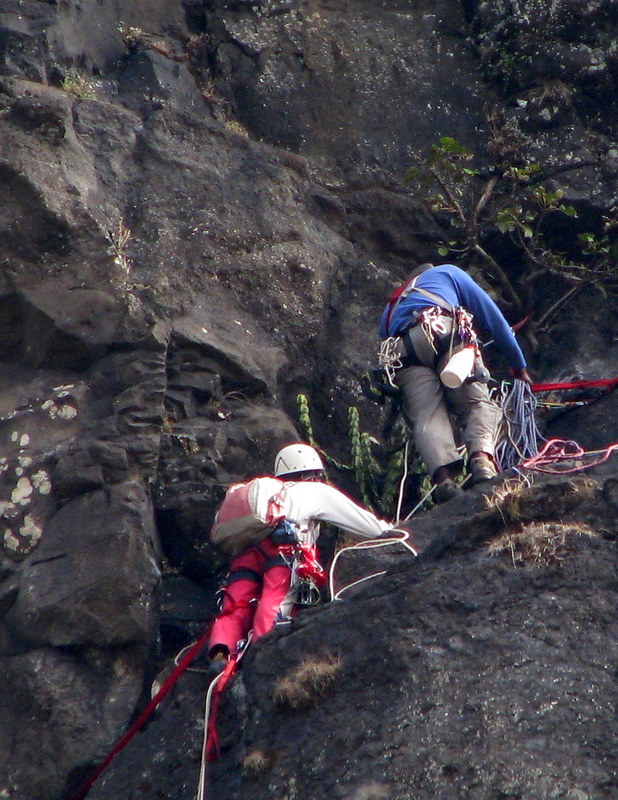
We started our climb form the temple side. There are bolts & pegs on the way for anchoring. Mallik took the lead & fixed the rope till the first ledge. He was followed by Zebnosh and the others followed one after the other.

By the time I reached the first ledge which was roughly at a height of around 100 feet, Zenosh had already started his lead climb to the summit. Within 20 minutes he summitted. Soon after Zen summitted the rest of us followed. By the time it was 5 we had all summitted and rappelled our way back to the temple. Zen was the last man to rappel down. By the time he came down, our Head cook Mallik was ready with some tea and had already started preparing for the three course dinner.

Next morning we were all up and ready for day two climb from the village route. While some of us stayed back to clear the place, the rest of the gang accompanied Ritzz and Zen for the climb. Ritzz led the climb upto the second leadge. The climb from the village route was a real challenging one. Sneha followed Ritzz and thereafter Zen, Jay and Meenaz followed. By this time I had given up and said I will not climb. But thanks to Meenaz, Farzin, Kinnari and Mallik who encouraged and motivated me. Not having climbed for so long I had no confidence and was not sure if I could climb. I was happy clicking everyone’s pictures at the base.

Then I was told I should climb up till the second ledge which is about 150 feet. So finally I decided yo! I am giving this a shot… but I had to remember the fact that once I stat climbing there is no option but to keep climbing till I reach the second ledge…there was no way I could climb down… I was prepared.

So I too climbed the vertical patch…the rock had excellent friction holds, cracks, pressure holds. I was glad I was getting some good grip..but yeah, the exposure on one side did get the adrenaline ticking faster..at one point I was right on top standing on my two feet with my index finger of my right hand in a finger hold and stretching out my left hand to get a good hand hold that Meenz was directing me to. At this point my legs were shaking..not due to fatigue, but I guess it was more out of fear of the sheer depth below…I finally managed to pull myself up and get on the first ledge where Meenaz was stationed to top belay. Phew.. the climb was indeed thrilling. With Meenaz belaying me I was also rest assured that I ain’t going to fall.

From this point I had a short traverse and then climb on to the second ledge where sneha, jay and Ritzz were stationed. This was a horrible stretch with lots of scree. I somehow managed and as soon as I got up there I self anchored myself, took stalk of my position and settled down in a narrow space. I knew I had to wait there for atleast next two to three hours before we rappell down. I wasn’t going to summit the village route.

The next three hours spent on the second ledge was awesome. I was literary on the cliff with the valley on one side, trees over on the plain before the valley… The only saving grace was the fact that we were in shade. As Ritzz, myself, Meenaz and KD waited at the ledge we heard that Zen had summitted successfully followed by Sneha and Jay. Everyone was elated. We were running out of time and we had a cut off time of 4 pm. It was already 3.30. So we decided we stop here and rappell down.

Unlike my first unnamed pinnacle climb this New Year’s weekend, this was a better climb. There was no climbing actually during the New Year’s climb. I actually did 250 feet of jumaring (ascending with a jumar device) which was a tiring task. Telbaila on the other hand was all about rock climbing. Infact I was told that its well known as the destination for beginners precisely because the rock is so good for gripping and holding. At the same time, there is a certain thrill factor involved because of the vertical nature of the climb … I personally had an excellent time climbing through the village route.

My confidence level has increased a bit now. I am also very thankful to Ritzz, Meenaz and the rest of the gang to take a novice like me on such a climb.

Wednesday, January 26, 2011

New Year's Virgin Pinnacle Climb! a great high


It was a new year well spent for me. I had the opportunity to partly scale a virgin pinnacle in the Trimbak region of Nashik. While it was a new beginning for me, for the Bhramanti Group of climbers from Mumbai it was a historic start of 2011. The 4 summitters- Kishor Chavan, Kaivalya, Suhas Shirke and Arun Sawant scaled their fourth virgin pinnacle on 2nd jan, 2011. The other three being Irshal crack, Sunday II virgin route and Bahuli III
It took them 3 full days to scale this 600 feet virgin pinnacle adding yet another feather to their cap. I can imagine the kind of adrenaline rush such a climb can give. For mountaineers and climbers anything that is out of the ordinary and challenging always gives a high. The other support members of the group were Tapan Vaidya, Prashant Sawant, Nitin Devedra, Dr. Narendra Patil, Ravi Bangera, Ritzz, Jay Seth, Meenaz Lala, Anusha (myself) and Sneha Sathe.
The Virgin Piannacle has been named “Rudra” by the Bhramantis, symbolizing hardship of climbing & an unexisting powerful entity. Rudra which is next to Anjneri fort is surrounded by other pinnacles such as Navra Navri, Hanuman, Sunday 1 and Sunday 2. So how was the experience of climbing a virgin pinnacle? Kishor, the lead climber says, “Absolutely challenging and exciting at the same time. We had to battle the cold winds and fixed 800 feet of rope to be able to summit the pinnacle.”
As per the Bhramantis, the virgin pinnacle climb happened by chance. It was not part of the group’s initial plan. The initial plan was to scale the Hanuman pinnacle. When the group reached Pahine, the base village they noticed this virgin pinnacle. When enquired with the villagers, they were told that was not Hanuman and did not know what it was called. The group was also informed that no other group had gone up this virgin pinnacle to climb it. That was enough to get the group excited. Not having the slightest clue of how the climb is likely to be, the group decided this is it and set out.
For Kishor it was the first virgin pinnacle that he was lead climbing. While he says he was a bit apprehensive he was also excited. “In a known pinnacle you are aware of the route and what is required. Moreover there is enough information available about the known pinnacle which you can gather from people who have climbed it before. That’s not the case in a virgin pinnacle you start on a new slate,” says Kishor.
Luckily the group was well equipped as the initial pinnacle Hanuman that they were to climb was a high grade pinnacle. The equipment was carried as per that pinnacle. The virgin pinnacle was attempted over a period of three days. On the first day (30th December) we started the climb at around 1.30 pm in the afternoon and finished by 5 pm before night fall. The first day we basically gauged the difficult and accordingly planned the climb and took the appropriate decisions.
On the second day (31st December’10) we started around 11 am and we stopped the climb at 5.30 pm. Third day we started around 9.30 am and around 3.35 pm I summited the pinnacle. The support team needed to be credited a great deal. If it was not for the support team the summit would not have been possible says Kishor.
It was a 600 feet vertical pinnacle but the route we fixed required more than 800 feet of rope. A group which is looking to attempt this pinnacle will require 3 coils of 100mt rope for the whole pinnacle. The first protection that Kishor had was at 100 ft and little above this point he fixed the first piton. I climbed further fising pitons and went a little more above and reached the first ledge. It was a good ledge to stay put. So the first day we stopped at the first ledge. Kishor was supported by a very strong climbing team that included Kaivalya Varma as the second climber, followed by Arun Sawant and Suhas Shirke.
On the second day Kishor jumared upto the first ledge and started the climb from there. We reached the second ledge and stopped here. The second ledge was at a height of about 250 feet. On the third day, the climbers started at around 9.30 am Kishor jumared till the second ledge and then started the climb once again from here. But he had a battle quite a few cactus growth on the way to be able to climb well.
After the four main climbers had reached quite a distance a decision was taken to let us amateurs climb as well till the second ledge. I was excited as it was my first ever pinnacle attempt. We did not climb but jumared the entire 250 stretch and then rappelled down.
On the third day the climbing team had kept a cut off time of 4 pm. As per the cut off time the climbing team had to stop the climb irrespective of whether they summit or no. It was decided that wherever the lead climber has reached if the clock ticks 4 he would return back from that point itself. But just as I got closer to the summit I could see the summit but it wasn’t easy to reach the summit. It was already 3.15 pm and we had really worked hard to get till there. So Kishor then finally decided that come what may he needs to summit in the next 45 minutes. Fortunately, for Kishor as he started his climb again he reached the summit within the next 15 minutes. It looked difficult but ended up being quite easy. Followng him Kaivalya, Arun Sawant and Suhas Shirke also summited by 4 pm. As they say all well that ends well
A little bit about the Bhramanti Group has been in existence for last couple of years and has been conducting several treks, cycling, rock climbing and mountaineering expeditions in the Sahyadris as well as in the Himalayas. Kailvalya was the group leader
The day finally ended for us at around 11.30 pm in the night. That’s when we reached the village. After reaching the village the biggest task the group had was to sort out the equipment. After having done that we finally left the village at around 1.30 am and I reached home early morning at around 7 am on January 2, 2011. It was indeed a great beginning of a New Year and a weekend well spent.

About Trimbakeshwar:

Now just a bit about Trimbakeshwar. It is a famous pilgrim place. Trimbakeshwar is also the origin of river Godavari. Trimbakeshwar is one of the 12 jyotirlingas (and the eighth one in the series) of Lord Shiva and this one is considered to be the main jyotirlinga. Monday is a scared day here and Shivratri the holy day of Shiva Puja in a year is celebrated here. The Goddess in this temple is called Trimbakeshwari. This temple was constructed by Raju Balaji Baji Rao who ruled Maharashtra. Very near to the temple, Papaharini Theertam is located. People take bath here before visiting the temple which is considered as a holy bath. This place is formed by river Godavari after falling from Brahmagiri. The Temple premesis is called Brahmagiri, also considered as the most sacred place of river Godavari (Brahma Sthalam).

Sunday, October 10, 2010


My NIM experience: My first ascent to Rudugaira Peak (5819 mts)

It’s been three months since I have come back from the Himalaya’s after my Advance course. But, I still like to remember those days as often as I can and feel good. I had not written down anything on my experience as yet until recently, when I remembered my days at NIM (Nehru Institute of Uttarkashi) again. I had just received my Advance Course certificate. Felt good reading it.
My certificate reads: Excellent Leadership Qualities and Team Work and is recommended for High Altitude Mountaineering expeditions and Alpine Camps. Thanks to my instructors for believing in me.
I should tell you a little about Uttarkashi. Uttarkashi (district) in Uttarakhand state is at an altitude of 4000 mts. The streets though are a maze of cobbled lanes. It will take a while before you familiarize yourself to this small town and its lanes. The houses painted in variety of warm hues from Ocher to pinks and cheer Blues make up for quite a palette. If you stand at a height and look at the township you can gaze at an amazingly medley of houses in colours that seem to glow in the warm sunshine. It’s a lovely sight. There is an absolute rainbow of hues, interspersed with lush greenery. The charm of Uttarkashi lies in its people and their hospitality, the small lanes and its busy market. A walk through these narrow lanes in the bazaar is a must. No wonder that I love the place and would like to visit it as often as I could.

My intention to do the NIM course was not for grades but to learn and learn in harsh conditions. The course both Basic and Advance teaches you to deal with harsh environmental conditions, how to work calmly with a team on high altitudes, communicate better in difficult scenarios, be disciplined, have control on your temperament and be mentally strong. These learning I would say have helped in my daily course of life and my professional life too.

The Advance course is tougher than the Basic course in terms of learning new techniques, carrying more loads, preparing an expedition plan etc. Moreover, the advance course students are expected to be role models for the junior Basic Course students. So you are constantly being watched. Your behaviour is under scanner right from day one. Here is a little tip on writing an expedition plan...For expedition planning it is very important that one must pay attention in every lecture and take notes. Also one must start writing a plan during the course unlike me who had left most of the plan to be written on the last day after reaching the hostel. I had to spend a whole sleepless night to write a good plan.

There are few things that are different at the advance course. Unlike in the Basic course, in advance the trainees are put up in camps at Tekhla rocks for advance rock climbing. We pitch our own tents and camp in Tekhla for four days.
Once back at the institute we have artificial climbing sessions, lectures and checking of all equipment and gear before heading to the mountains.

This time around we were taken to Gangotri Glacier instead of Dhokrani Bhamak Glacier. Gangotri is a holy place. It is the origin of the river Ganga and seat of the goddess Ganga and is one of the four sites in the Char Dham pilgrimage circuit. Here you find tourists, pilgrims and mountaineers (Indian and Foreigners). This small town is centered around a temple of the goddess Ganga , which was built by the Napalese General, Amar Singh Thapa in the early 18th century. A visit to the temple and the market is a must here. It’s extremely colourful and the roadside restaurants are most often packed during the evenings, thanks to the tourists and the mountaineers.

The course was a daunting task. Steep ascent with 20 kg load on your back, walking on moraines and avalanche prone areas is no mean task. Our first long trek in to the mountains was really long. This started at Gangotri (Camp 1 at 3080 mts) to Nalla Camp (Intermediate camp) which was at 4280 mts- a height gain of straight 1200 mts… that was a huge. Many were tired and frustrated..some even snapped at each other... its natural..but in mountaineering this is what you are not supposed to do and control your temperament. While some of us were slow and were able to do it, most found it difficult. Many fell ill as soon as they reached the campsite. Reason: they were not well acclimatized and got acute Mountain sickness (AMS). Some even got high altitude pulmonary oedema HAPO).

The place was however beautiful. We could see Jogin peak from our camp site and it had a beautiful scenic surrounding. We were at this intermediate camp for two days due to heavy snow fall. We witnessed upto 2 feet of snow on the first night at the intermediate camp. The snow fall practically kept us awake the whole night as we took turns to shed off the snow from our tents. Lest it wet our tents. The porters and our instructors were also helping us in this task.

After two whole days at the intermediate camp, the third day we proceeded to the base camp at (4600 mts). This was also a beautiful picturesque place surrounded by peaks like the Gangotri Massif (Gangotri 1, 2 and 3) and Rudugaira. The trek to the Base Camp wasn't so bad.

While at the Base Camp we were trained on the Glacier and Snow. Training on the glacier wall involved revision of basic techniques, aid climbing, two piton base climbing, tip toe climbing and climbing using double ice axe.
Snow craft included Toe kicking, Side stepping, heel kicking; Glissading; Different types of belaying; Ice axe retrieval; Crevasse crossing; Rescue techniques in crevasse using C pulley and Z pulley; detecting avalanche prone area; lecture on avalanche rescue using a revolutionary system called Tracker Digital Transceiving System (DTS).

Just to explain what is DTS? It is designed to simplify multiple burial situations. Once a signal is found, the Tracker directs the searcher to that signal. If a second transmitter is detected during the search, the Tracker stays on course and continues to guide the user toward the strongest signal. Once the first victim is located and uncovered, the transmitting beacon should be switched off and the search for the next buried individual should begin.

After all the training and taking into account the weather conditions it was decided by our senior instructors that instead of summiting Gangotri-III (6577 mts) we would be sumitting RuduGaira peak (5819 mts). They decided against Gangotri III due to bad weather conditions. Infact even Rudugaira was a big ? but instructirs decided we would trek to the advance base camp and then decide the future course of action.

So day 14 of our training we got ready early to march to the advance base camp (4920 mts). Although the load we were carrying was less the trek was tough. We encountered steep walks, moraines and bad weather to add to it. But finally when we reached our camp site all the tiredness was forgotten. The best part was that the tents were already pitched. Amidst cold wind and bad weather it was extremely soothing sitting inside the kitchen tent and having hot cups of tea and snacks along with all the instructors. After a while we went for an acclimatisation walk which was good. The best part was that all the 19 of us were well acclamatised and raring to go. We couldn't resist the thought of summitting RuduGaira.

Once back at the camp site, each team had to cook their own meal for the night. We were given Maggie packets and few other ingredients that we wanted along with the gas burner and utensils. This was part of our training to cook in the high altitudes.

As I sat outside the tent to cook the Maggie along with my tent mates Indira and Maj Geetanjali, we had a lovely panoramic view of the mountains Manda1, 2, Brighupanth, Jogin on one side and on the other side; we could see the Gangotri massif. It was sunset time and we could see the tip of the peak shining gold. We finished dinner by 7 and were all ready to hit the sack. The next day was a big day for us –‘The Summit Day’ -The summit of Rudragaira peak(..5819 M) ;

The first group headed out at 4 am to open the route. The second group left half hour later. The weather was good but windy. The temperature was sub zero with 2 to 5 feet of snow. I wore 6 layers of clothing – 2 T shirts, 1 light jacket; 1 feather jacket and a wind proof jacket and windproof trouser with gaiters, snow boots, helmet and all technical equipment including ice axe and rope.
I maintained a steady pace all through but walked towards end. It was a steep walk all through and the weather was on our side. But we could not delay and had to summit by 9 as the heat was getting harsh. Once the snow starts getting loose it would be a tough for us to descend.

The first batch summitted almost an hour before the second batch. Nevertheless a few of us kept each other motivated and we all finally made it. Except three girls who mentally gave up towards the end. It was our first all woman Ascent to Rudugaira on June 17, 2010. It was a great sense of achievement for all of us. We spent hardly 2 minutes on the top of the peak and had to immediately start descending.

The descend was killing. After a while we had to put on our crampons as the snow got loose and it was difficult getting a grip to walk down.

But as they say all’ well that end’s well. Each and everyone reached the advance camp safely.

The course has helped me hone my technical skills but as they say no amount of training helps unless and until you continuously practice it. The expedition was one hell of an experience. After you have experienced it, you realize what it takes to be a mountaineer.

Wednesday, May 26, 2010

Back at NIM !!!!

The last time when i took a month's leave and said i was going to climb mountains and learn mountaineering my friends and colleagues thought why would you waste one month doing something like this. Would you not rather spend your time in some luxurious holiday. Well i didn't pay heed to that last year and this year again i am back at NIM for my advance course in Mountaineering and so are many others from my previous basic course. It just seems like we all met only few days ago. The weather here is fine currently. Slightly cloudy with pleasant breeze. The afternoons though have been extremely hot. Hopefully the weather will remain pleasant through the night and tomorrow. Watching the girls who have come for their Basic course brings back fond memories of the past. I see the same look and apprehension on their faces which was so starkly visible on my face last year when i was here for the course. Despite having read up all about the course and also having spoken to many of my friends about the course i was still apprehensive about what was in store for me.
This time around what's interesting is the mix of people who have come to do their basic and advance course. There is a Bharat Natyam dancer from Chennai, an architect from Delhi, a Spanish teacher and translator from Mumbai, a graphic designer, a homeopathic doctor and i am sure there would be many more. The one thing that has brought us all together here is the passion for adventure sports.
Right now we are all waiting for the induction programme to begin later this evening when the dos and dont's would be reiterated to us. This year is going to be exciting for us as we are told that we would be going to Gangotri III. Right now i just can't wait for the course to start. It starts tomorrow but the wait seems too long.....

Friday, April 30, 2010

Reporter's Diary from Dantewada

15.04.10
1600 hrs, Dantewada, Chattisgarh


Right from the time we set out to leave from Mumbai for Vishakapatnama and then to Dantewada in Chattisgarh we were constantly warned of the place and asked to take care. On the surface everything seems normal but deep in the jungles is where all the action is happening.
The journey into the naxals heartland in Chattisgarh involves a 70 to 80km hike, winding through thick jungle over the mineral-rich Bailadila Hills and on through a number of naxal -controlled villages. While, it was obviously difficult for us to capture those dark tales when we were there nevertheless we managed a bit.

Dantewada:

We crossed the borders of three states (Andhar Pradesh, Orissa and Chattisgarh) to finally enter Dantewada. Ever since we stepped into the district –South Bastar area at around 4 pm in the afternoon that the eerie feeling set in. It is one of the most backward regions and district that I had ever been to in this country. It is a mineral rich resource state and if companies are allowed to do business here, it could probably give a fillip to all-round development in the district. But unfortunately, there has been no concrete development in this place for the last 30 years except for roads.

For the main district town-Dantewada has nothing much. The streets look deserted. We got out of our AC car into scorching heat biting in to our skins to find out if all was ok.. have we come on a wrong day, is there a problem.. all sorts of questions was crossing my mind…Finally on enquiring with a local shopkeeper, he tells us that shops are shut because of a weekly off. Strangely it was not hustling district town. We spotted only few locals on the streets. Found out there was only hotel (Madhuban) tucked away in some corner, no petrol pump, no cinema hall or even a children’s park and no auto rickshaws were visible either. There is one district hospital which has just about 22 doctors for the entire town. Manoj, a local shopkeeper tells us if one meets with an accident or is seriously ill he or she will have to be rushed either to Raipur or Visakapatnam both of which are equidistant from Dantewada.

We decide to go meet the district collector. To our surprise we find this young lady IAS Officer Reena Kangle. She has been posted there for a year now. Amidst all the eeriness she came as a breadth of fresh air. I was surprised to note that in a place where no sane person wants to go, here is this young lady who is the district collector and trying to bring some order in to the place.

She tells us the pathetic situation of the South Bastar region. “This is the most backward regions,” says Kangle. When asked about the hospital she says: “32 specialist doctors’ posts are still vacant here. Nobody is willing to come here.”
Of the 1700 schools in Dantewada, 200 have been blown off by the naxalites in the inner villages and the others have few teachers. “Dantewada is the least literate districts in the entire country just about 25 per cent of the 5.5 lakh population are literate,” says Kangle.
I was amazed to find out that a five year old in the villages of Bastar region or in the villages in Dantewada knows how to blow up an ID bomb or a land mine or even make a tiffin bomb, but they do not know how to write their name or count. Tiffin bombs as we understand from the police authorities are Naxalites greatest strength. These bombs come inside a steel tiffin box and is enough to blow up a jeep.

Moving freely in Dantewada or Kirundul and Bacheli which is about 40 kms from Dantewada main town gathering information was a difficult task. Kirundul and Bacheli is where the iron ore mines are situated.

The silence speaks volumes of intimidation and fear perhaps more from the naxals. The locals are not willing to talk. They do not want to be seen talking to strangers in their town as they would not want to be considered as any kind of informers out of fear of being tortured and killed by the Naxals. Somehow we found our own way to tackle the situation.

Naxals may not be visible to us or even the locals but they make their presence felt by blowing up schools or call for a bandh and disrupt services in the district. They run their own parallel economy and so called government.
The schools are blown up thinking they could become good fortresses for the police forces. In the last year alone they have blown up 12 residential schools building in the central and Southern parts of Dantewada. These are schools for the tribal children in the villages.

What’s surprising is that despite all their atrocities, there are sympathetic voices for these naxalites from educated and well-informed people, who deliberately seem to be ignoring the real menace.

Who are these Naxalites?

A chance meeting with Mahesh Babu (name changed), a surrendered naxalite and who is now a SPO (Special Police Officer) with the state police force brought to the fore the point that the under the garb of alleviating the suffering of the tribal people, their only mission is to loot the rich to buy expensive sophisticated weapons to run their parallel government. None of the money that is being extorted in the name of tax from the local villagers and businessmen is being used for development of the tribals. They are not doing it and they do not want the government to do it either.
“They have their own political agenda. The tribal people’s cause is a façade to cover their evil desires. Most of these naxalite leaders’ kids are studying outside whereas they do not want us tribals to get basic education as well,” Babu says.
From a village in the Bastar region, Babu joined the ranks of the naxalites when he was just 12 years old.
His family comprised of his peasant father, mother, brothers and sister. Babu was brain washed and inducted into the naxal movement in 1993 when the naxalites had come into their hostel building in Dronapal to propagate their movement. They spoke of their ideology by saying that “You cannot end the world’s injustices without stirring a revolution and no revolution happens without bloodying your hands. We are fighting a people’s war – a protracted people’s war.”
Flown by their ideology Babu joined the movement. Like other rebels, he was offered no salary, only the promise of liberation. There were many others like him at the jungle hideout including girls.
He spent three months at a Maoist camp. He was given all the necessary arms training like bow and arrow training, handling of the 12 bore 303 rifle, guerilla tactics; learned how to make and plant bombs, ambush police patrols and attack police posts etc.
By the fourth month, he was ready to embrace the gun and die for the movement. He also rose to the rank of deputy commander and was based in the jungles of Orissa within a year.
“Initially when I got inducted the ideology was to stop the atrocities that the local rich people committed on the adivasi community but later on I realised that the ideology was just a farce. They were actually keen on looting people for their own benefit. Their ideology is wrong. Most work for them including the villagers as they fear for their lives. The Naxalite leaders say they have no desire for money, then why do they themselves run away with the money? What are they struggling for then?
They say this struggle is for establishing their own government. They say they will wipe out the police and set up their own government. That our lives will improve, but I knew that this is untrue. It will never happen.
I then decided to run away and get out of the shackles of the naxalites. In 1996, I got that opportune moment I was waiting for and ran away,” Babu says.

Since that day Babu has been living in constant fear of being killed. His father and two younger brothers have already been killed by the naxalites. And in the recent past Babu himself has been attacked several times. His body is full of cuts and wounds. Babu now tries to save himself and his mother and younger sister. But he says life is better now than what it was in the jungles. He now works for the Chattisgarh police as a Special Police Officer (SPO) and is paid around Rs 3500 a month. He hopes that some day he will be roped in as a permanent employee in the state police force.

These surrendered boys and girls are roped in as special police officer as they are well informed on how these naxalites operate and also know the jungle routes etc.

Mahesh’s account of what the training process entails

We used to wake up at 4 am for PT and drill, followed by breakfast and then the leaders would talk to us about the teachings of Mao and their way of life. After this we would have lunch and two hours rest followed by PT, drill, training and tea.
In the night after dinner we went to the jungle for night training. Later we were sent to a larger camp for training, here we were taught how to draw maps of police stations, how to gherao police posts, how to snatch a rifle from a constable. We were trained by military commanders. On an average 4 to 5 batches get trained there. The routine at all these camps are the same. We are also trained in self defense in case we came under attack.
Everything that these naxals do is much planned. In the camp they give orders and tell you that today you have to kill. If they order you to kill, you have to do so. They allocate the duties during roll-call, you can't be scared, you have to carry out what they tell you.
They don't even give any money for the work they make us do. The commanders keep all the money and sometimes run away with it. Even if you ask them to give you some money they don’t. They get crores of rupees. The leaders don't fight on the ground as we do. All they do is brain wash the tribals and loot the rich villagers and kill all those who oppose them and hold meetings.

Current Situation in Dantewada:

The police authorities along with the district authorities are doing their best to restore peace in the region and also doing their bit to educate the tribal children. There are several ashrams being run for the children who have been orphaned by the naxalites.
One such ashram in the main district town of Dantewada is the state-run Astha Gurukul School which houses 150 kids. Most kids here have seen their parents being killed brutally before their own eyes and they now want to avenge their parents death and for spreading bloodbath in their State.
“We want to get the 6 to 18 year olds out of the clutches of the naxals and educate them,” says Kangle. DSP Sanjay Sharma says
“How to inject an achievement drive in this region is an issue we are trying to tackle,” says SP Amresh Mishra.
Currently, all efforts are currently on to restore peace, law and order in the district town.

                          The Pandemic and the Mind  Mental Health is a serious issue over the last few months. Children, young adults to Se...