Wednesday, May 15, 2013

Himalayan Glaciers receding at an alarming rate.....


Every time I am in the Indian Himalayas and especially where there are glaciers its alarming to find how Glaciers are receding. Today, I read a report in a financial daily on how Mount Everest glaciers are receding. It was reported that recently, at a meeting of the Americas in Cancun, Mexico- a Scientific Conference organized by the American Geophysical Union, a studyt was presented which indicated that Mt Everest is losing cloak of ice and snow. Mt Everest glaciers are receding and have shrunk at an alarming rate of 13 per cent over the last 50 years due to global warming, the study says.
This is true of the the glaciers in Indian Himalayas as well. I can certainly talk of the Dokriani Bamak Glacier in the Garahwal Himalayas of Uttarakhand. I was year in 2009 when I was pursuing my basic mountaineering course at t e Nehru Institute of Mountaineering (NIM). Dokriaani Bamak glacier is where we are taken for our ice training.
I was shocked when I was told by one of my instructors that the glacier here was receding at the rate of 1.5-2m every year. I was told that the glaciers 25 years ago extended right up to where we had now set up the base camp. That was shocking as from the base camp to the glacier where we used to go for our Ice training was a neat 2.5 to 3 km walk on moraines. Similar is the case in Nepal. Local mountaineers experience says that the base camp of Everest used to be half an hour trek from the village but now, glaciers have shifted and moved and camp is now three hours away. These intrigued me to find out more. 
According to the information I gathered from the Wadia Institute of Himalayan Geology at Dehradun, Dokriani glacier is one of the well-developed, medium sized (7.0 km) valley glaciers of Gangotri group of glaciers in the Garhwal Himalaya. The glacier was originally mapped in 1962–63 and was remapped in 1995 by the Survey of India. The glacier shows rapid frontal recession, substantial thinning at the lower elevation and reduction of glacier area and volume.
Between 1962 and 1995, glacier volume is estimated to have been reduce by about 20% and frontal area had vacated by 10%. The study revealed that during the period 1962–1995 the glacier has receded by 550 m with an average rate of 16.6 m/yr. However, the yearly monitoring of snout position of the glacier during Gangotri glacier in Uttaranchal.
India’s glaciers are melting fast and the Inter governmental Panel on Climate Change (IPCC), the scientific body meant to study climate change, warned in 2007 that if steps were not taken to check this, there was a likelihood of water shortage in rivers (when needed) and flooding of coastal regions.
According to researchers at the Wadia Institute what was worrying is that the glaciers are losing density... largely due to global warming; the snow is melting faster than it can accumulate as ice, thereby thinning the glacier.
The Himalaya, the youngest and fragile mountain system of the earth, has direct influence on climate control, regional hydrology and environment of our subcontinent. About 17% of its mountain area is covered by glaciers. These glaciers are receding faster than those in other parts of the world
The Himalayan Glaciers and Ice Caps are considered water Tower of Asia since they store and supply water downstream during the dry season. Downstream population is dependent on the melt water for agricultural, drinking and power production. In the long run there is a possibility that the region will face severe drought problems. Farmlands could dry up, there could be lack of drinking water.
If this is the scenario in all probability it could also affect the downstream population economically.


Sunday, April 28, 2013

Blissful ride along the Konkan Coast


It was a new found freedom for me…I had quit my job after six years of being in one magazine. And, the first thing I did after quitting was to take off on a bicycle adventure trip the very next day. Accompanying me was my Friend Deepak Kasthwal and our mean machines ‘our beloved bicycles’. Destination was unplanned all we knew was we shall ride along the Konkan Coast via Alibaug.


December 21, 2012 was the day. We took off from Bandra (West) at 6 am in the morning. Headed straight to the train station from where we were to take a local train to Charni Road and then bike from there to Baucha Dhaka-the Mazagaon Ferry Point. We got the ticket and waited at the platform for the train heading to Churchgate.
While at the station I realized how Mumbai is so not a Bicycle friendly city. We had to literally carry our Bicycles on or shoulders up those uneven stairs from platform no.1 to platform no.4 to get a fast train. As the train arrived, the luggage compartment was crowded. Somehow we managed to get ourselves and our cycles inside the compartment only to realize we had got into a Dadar train. But, we were glad we did that so we decided we would ride from Dadar to Baucha Dhaka- Mazagaon Ferry Wharf.
At Dadar, once again we had to battle our way through the platform, carry our bikes and walk up the stairs to get to Dadar east.
Before we started off on our ride, we had a nice cup of hot tea right outside Dadar station east. Standing with our mean machines and dressed in our biking gear we were obviously the Centre of attraction early in the morning. One thing I like about India and its cities is that people do not wait to make small talks if they see something unusual. In this case we did come across as unusual as we had our backpacks stashed away at the back of our cycles and we were dressed in our cycle gears.
People were keen to know if we were participating in some race, how costly were our bikes and where were we off to and for how long? We battled all these questions till the time we finished our tea and once we were done we took off. It was a nice pleasant ride. We took the port road which was fairly empty that early in the morning. We went via Parel, Kala Chowky, Cotton Green to Mazagaon.
We got the 8.30 am ferry to Rewas. It was a beautiful sail watching the Seagulls eat anything and everything thrown at it including ‘Vada Pav’ and ‘Kurkure’. Once at Rewas, Alibaug is another 23 kms flat pedal. As we rode on the busy streets along the way we managed to stop by and explored. We came across a new factory outlet of clocks-clocks that were got from the Mediterranean and sole real cheap here. So folks when on the road to Alibaug from Rewas look out for this antique clock store on your left……
We reached Alibaug and a bit further down stopped for lunch. Our next destination was Korlai enroute through Revdanda. The route from Alibaug to Revdanda is again through beautiful country side. Since we were only the two of us we rode at own convenience and pace. All along the route we had people and kids screaming out to us in English ‘hi’ , ‘hello’..
After an hour’s hiatus, it was time to go full steam and hit Revdanda. A pretty village with a seaside fort, it also has the Shree Rameshwar mandir and the Revdanda fort.  Shree Rameshwar mandir has an ancient shrine of Shiva and it is said it was built in 'Hemadpant' style of Architecture, though, when it was built is not known. Angre history references say that it was renovated many times. The structure comprises of prayer hall (sabhamandap), sanctum sanctorum and 7.62 meter high summit shaped dome. In front of the prayer hall, there are three tanks (kund) namely Parjanya Kund, Agni kund and Vayoo kund. We stopped by this temple and soaked in the cool breeze and the serene and calm atmosphere.
Further down is the Revdanda fort. 17 kms from Alibag Revdanda is an important port. The Salav bridge at Revdanda which joins Murud and Alibag gives a cool view of the surroundings, You can see a beautiful sight of Revdanda port and beach. The fort was built by a Portuguese Captain by the name of Soj in 1558.
Since both of us had been here before we decided to carry along straight to Korlai. It was past 4.30 pm and we had about 90 min of daylight before halting for the day. Being the first day, we had no intention to push our limits & do a night sojourn. We were sure we would make it to Korlai by 6.
The day’s proceedings evolved into a nicety, with us reaching Korlai by 6.30 pm as the radiance of dusk cast its shadows on the sandy beach. Korlai is a beautiful quaint and lesser known Portugese enclave on the slopes of Konkan range between Arabian Sea on the west and Revdanda back-waters on its east.
One of the most interesting things about Korlai, is its name. This small island was once called ‘Morro de Chaul’. Morro, in Portuguese, implies ‘a small, rounded hill. The present name – Korlai fort, comes from the village of Korlai on the foothills. This name also comes from the Portuguese – the residents of this fishing village speak a dialect of the Portuguese Creole called ‘kristi’. The word Creole eventually was distorted to Korlai.
The fort is open to one and all to take a walk. There is also a light house which is open to all. The lighthouse is open for visitors between 4 PM and 6 PM, and someone is always present there to help visitors who arrive at the wrong time. One can walk up the winding stairs of the lighthouse and learn all about how the light house functions. It’s fascinating. The guides are very good and knowledgeable.
Once at Korlai village, we were lucky to find a homestay at Yogesh’s place. A good family man with a wife and two kids, he was trying to supplement his income with offering homestay along with breakfast and food. He had recently done up two rooms on the first floor which he was letting out on rent for blokes like us. Extremely, hospitable his wife made excellent dinner that comprised of Rice Bhakri, Gaoti (Village) chicken, some salad, fried fish for Deepak and plain rice. The food especially after a 90 km cycling was just yummmm!!
We crashed soon after dinner as we had an early start in the morning. We were heading to Murud which was a pedal of 32 kms and from there to Rajapur jetty (3kms) and from Rajapur we had to get on a ferry to Digi and from Digi to Diveagar. Digi to Diveagr was another 23 odd kms. So it was going to be another long day of a beautiful ride along the coastline. 
After a good night’s sleep we headed out of Korlai around 8 am. The ride along the long stretch of coast line to Murud was scenic and breathtaking. On the one side was mountains and the other side the Arabian sea. We savoured every moment of it.  We passed through the crowded Kashid beach, then Nandgaon where Dr Salim Ali (India’s best ornithologist) has his beautiful and palatial beach house. The sand on the Nandgaon beah is white and this particular stretch was a virgin beach with the crowd staying at Kashid. I am not a beach person so I don’t really enjoy spending time on the beach.
We did not halt and headed straight to Murud. We wanted to be at Murud right on time for Luch. We lunched at a local hotel by the beach. After lunch we immediately headed to Rajapur jetty from where we took a launch to Digi jetty. From Rajapur there are regular boats that also take you to the Janjira fort which is majestically located in the middle of the Arabian Sea. As history goes- Janjira was a fort which the great Maratha warrior king Shivaji could never capture. That's why his son built the Kasa fort on an island close to Janjira in order to capture Janjira, but that never happened. Janjira fort has stood there for 950 years.
And amazing piece of info for you dear reader is that the fort is built in such a way that till you get about 100 or 200 meters from it, you just can't see the huge entrance.
But first some trivia on Janjira: It's huge and you can easily get lost. There is 20 acres fully fortified. I have never seen a complete fort ever on all my earlier treks in the Sahayadris. Inside the fort there were amazingly two huge sweet water lakes. One can drink water from a deep well. It is crystal clear. What a miracle! Salty water all around and sweet water on the island! I have explored the fort in the past. The stones used to build the fort have taken a battering over the centuries but the joints used to connect these stones are still as they were. The Nizam of this area also built an underwater tunnel right to his palace on the shore. One can even venture into the dark tunnel but you require a powerful torch
Once at the jetty we got a launch to Digi. The sail was good but unfortunately women are not allowed to sit on the open top area as it’s against rules we were told and the boat man can be fined by customs or coast guard authorities. So I had to sit along with the crowd inside.
Once at Dighi, we had to pedal fast to get to Diveagarh before it got too dark. Diveagarh was approximately 23 kms from Dighi jetty. It’s a strenuous ride with some uphill rides. We reached Diveagarh around 7 pm. Since we hadn’t booked a place we went hunting for a stay. And we were lucky to find a place. It was an okay place and we paid 750 for a night which we thought was a little too much. But as they say Beggars can’t be choosers …. Next morning we were heading out to Shrivardhan. We had dinner at a local place which served good fish and chicken and sol kadhi ( a traditional Konkan drink). 
After a decent night sleep, early morning the two of us decided to take a walk along the beach. Little did we know that at that hour it was going to be so crowded, noisy and dirty? I was thoroughly disappointed at the state of that beach. It was no more a virgin beach and it was full of litter. Apart from the beach, Diveagarh is famous for its famous Golden Ganpati temple. Sadly eight months before we were there, the golden ganpati idol was stolen, melted and sold in the market.
We had breakfast at the same local hotel where we had dinner the previous night and headed out to Shrivardhan at around 9.10 am. It was a ride of another 25km to get to our destination. Srivardhan is again a nice, sleepy town like Diveagarh. It was a fantastic ride with lots of uphill as well as downhills. Downhills are great fun you can feel the breeze as you ride.
At our last stretch of downhill towards Shrivardhan, the first village you encounter is Kondivili, a beautiful quaint village just by the vast sea. We reached here at around 11.30 am. The view from the top as we were riding down was so beautiful that as we got closer to the village we decided why not stay here and then we could just do some riding around. Right at the beginning of the village we found this beautiful homestay where the owner lady was also kind of tell us that she can prepare good lunch and dinner and offer us as well. It was an invitation we could not have rejected. So we deiced let’s stay put here. The beach across her house was clean and not a soul. 
Towards the evening we headed for some adventurous ride on the beach. As the sun was setting we rode along on the white sands. It was an amazing feeling which one seldom gets in the city of Mumbai.
Towards the night we decided against going all the way to Shrivardhan. So Kondivili was our last halt and next morning we headed back to Dighi jetty and once again pedaled back on the same route to Mumbai. On our way back we halted at a friend’s place at Nandgaon and also went again to Korlai and explored the fort and the light house all over again with some other friends. And next morning headed straight to Alibaug-Madwa-Gateway of India.
We had done close to 450 kms to and fro over 5 days. It was a pleasurable and great ride along the Konkan Coast with lots of learning as well.

Monday, March 11, 2013

Short Escape!


 I have been waiting for really long to start writing about my travels once again. Despite having traveled so much last year I haven't got down to chronicling it. Don't know why?
But, now I have a good topic to start. Two days ago I went to Matheran, a hill station which is about 90 Kms away from Mumbai. I have fond memories of Matheran. This was the place which introduced me to nature when I was just 7 years old. And, since then I have been traveling to places where the mountains kiss the clouds.
So what took me to Matheran now? Well, it was an invitation from Lonely Planet India for the launch of their Short Escapes from Mumbai guide.
The Short Escape guide is a guide that has been launched in Mumbai, Delhi and Bangalore and it captures all the destinations that are close to these cities. Unlike the usual Lonely planet guide which have small fonts and lots of details, these guides are well designed keeping in mind the travellers’ needs. The guides have a good mix of large pictures and big easy fonts that are easy on the eyes and therefore a pleasure to read. Each of these guides feature 40-45 destinations and are divided by themes such as hills, heritage, wildlife, beaches and resorts. Economically priced at Rs 395 these guides are ideal for someone who is a migrant into these cities on work. But, that does not mean that people of these cities cannot use this guide it is useful to them as well as I know of many Mumbaikars who have no clue which are the places outside of Mumbai.

Now a little about Matheran

Matheran, touted to be the smallest hill station in Maharashtra, is indeed a great escape for the busy Mumbaikars as it is very easy to get here for some pure, clean and fresh air. Sparing a few look-out points and waterfalls, there's nothing much to the hill station. This time around I did notice a few changes at this place. For one the toy train is functional again. Secondly, the road from Dasturi Naka to Aman Lodge which is the first train station after Dasturi to Matheran market is now well laid out. I just hope this road does not extend right till the market place. If it does then the entire charm of trekking on red mud will be lost.  
Matheran is an Eco-sensitive and fragile region and hence motor vehicles are not allowed inside this serene place. Vehicles are allowed till Dasturi Naka from where one can walk to the place that they are staying. As u walk in right at the beginning there is Aman Lodge station, the toy train station that can take you to Matheran station located close to the market place. So if one does not want to take the train (shuttle) from Neral. They can get a train from Aman Lodge. Chugging along in a train that lazily bends around the mountains, breathing in the scents of sweet-smelling medicinal herbs and watching the green cover of the Sahayadris is an amazing experience. This short train journey cuts down on your walk if you are not keen to walk all the way on the red mud.
One thing you need to remember is that the trains operate according to their respective timings. So one will have to go there and check if there is a train. One can also ride on a pony or a horse back to get to the market area or their hotel.
A handful of hotels and homestays are scattered across. This time I also noticed couple of new hotels has started here. Most of the restaurants in the market place now serve Chinese and other kinds of food..
Lonely Planet had chosen the Neemrana's 'Verandah in the Forest for us to stay. The Verandah was initially called The Barr House owned by Col Barr and then bought out by a rich Parsi family in Mumbai who eventually sold it to Neemrana. The house is palatial and has a big garden and a tree house. The rooms are all old British style. It's located amidst the forests and has a huge Verandah and hence the name.
Matheran in all has about 38 points, a lake called The Charlotte lake is the only lake at that height. The place is ideal for lazing around and doing anything. The only activities that visitors here can engage in is to walk further into the mountains and soak in the green foliage.
Some of the famous points here are the Panorama Point from where you can see the Sunrise, the Sunset point. Both the sunrise and sunset view is beautiful as you can see the sun casting a beautiful glint of deep orange across the entire region, The Charlotte Lake and the Pisharnath Mahadev temple are the other places that one can visit while here. The Charlotte Lake is a nice place to sit and read a book. The other points that are worth visiting are the Louisa Point (from where one can view the mighty Prabalgad, Irshal gad and Karnala fort), Rambagh Point, Echo Point to name a few.
Matheran is a quiet, peaceful place, and this characteristic of it has often given rise to the myth that it is haunted. Locals narrate tales of wronged wives and separated lovers who float along the woody paths. While there's nothing to be scared of, such anecdotes complete your trip


How to get there
- Matheran is well-connected both by road and railways. Buses frequently ply to Neral from Mumbai and Pune. From Neral one can avail share a taxi till Dasturi Naka. A toy train from Neral is also available and leave you right upto Matheran station. If not one can also take a train from Aman Lodge which is a 5 minute walk from Dasturi.
- Even though hand-pulled rickshaws and a few vehicles run by the municipality can be found in the heart of the hill station, the best way to experience Matheran is by foot or on horseback.


Thursday, April 26, 2012

'London Memoirs'


Chevening South Asia Journalism Programme:

What can I say about London that you don’t already know? Besides being the most visited tourist city in the world with its disrepute monarchy, London indeed has a lot to offer. First of all, its cultural diversity needs to be applauded. Asian restaurants, African shops, Belgian chocolatiers, Parisian fashion are all testimony of its cultural richness that is so starkly visible at every turn.What’s amazing is the seamless merge of history and modernism on every  street. 
To tell you about my scholarship programme-well its after 6 years that the Chevening Scholarship programme has been opened up for Indian journalists. This time around it also opened its doors to journalists from Pakistan. It's a 8 week programme for senior journalists and the central theme of the Course is Good Governance in a Changing World: The Media, Politics and Accountability. The course is different from the previous scholarships in the sense that previous programmes there was fair amount of training on how to write. In this programme we are not being trained to write but being trained for leadership skills and right decision making abilities etc.  We are expected to write an academic paper for the topics we have chosen for our individual projects. 
Its been an interesting three weeks so far with loads of lectures, seminars and study visits to places like the British Library, BBC and Sky News, Oxford and Cantebury, attending seminar's around the central theme. In the first week. we had sessions on the Future of Media. In the second week it was all about Holding the Powerful to Account where we discussed accountability of Media, morality and community, whether the Media is trust worthy. In Britain do people trust newspapers or TV news and surprisingly, BBC scored higher with people trusting the BBC to another newspaper or TV news channels or even the Government. The third week saw some interesting sessions on Social Democracy, Ethics and Values.  We got an insight into the Levenson enquiry of the phone-hacking case. Also it was interesting to note how even organisations like BBC and Sky News have moved into integrated news rooms. 
BBC's headquarters has shifted this month from the histroic Bush house to bigger office building comprising of 8 floors and very large Integrated newsroom where all journalists across, TV, Radio and Online will be sitting together thereby sharing resources. Similarly, Sky News also has an integrated newsroom. Indeed, the integrated newsroom has achieved substantial savings for BBC that helped compensate for declining licence fee income.So has integrated newsroom become need of the hour or is it is just a cost cutting mechanism. a senior official at BBC says its both. While cost is reduced drastically with synergies being drawn from various sections and one journalist doing more than just reporting for TV but also doubles up as a radio correspondent and writes of online etc....and vice versa. Integration has indeed become need of the hour today across the world. Many across the BBC are being taught new skills so that they can work seamlessly across the various platforms of delivering news. 
We are into our Fourth week of the course and its been hectic so far. This week our theme is How Britain sees the World?. As part of this theme there are visits to the Trade Union Congress, The British Parliament, House of Commons and the House of Lords. Week 5 will see us discussing Governance, development and security.  We have been meeting up with some very senior journalists from the BBC and Sky news for instance we had a session with Tim Marshall -the war and foreign correspondent of Sky News, Andrew Whitehead who spent quite a few years covering South Asia based out of Delhi to name a few. 
All in all the scholarship programme is good. Unfortunately we do not have a choice in selecting our placements.   
We are also most fortunate to be also living the most happening place -'Hyde Park'. The 335 acre huge Hyde Park is just 5 minutes away and therefore do not miss out on my morning runs or cycling. The nearest tube stations are Queensway Station and Bayswater station. Just as I am thorough with the Mumbai trains routes here too I have got very comfortable with my daily tube travel and more or less familiar with all the zones and lines on the tube. Tubes or buses or walking is the best way to travel in London. And last but not the least I have been pub and club hopping here and drinking loads of different kinds of beer.
A visit to the British Library: 
A library is a wonderful place, where you can lose yourself in a breathtaking world of science, travel, fiction and more. And I had the opportunity to visit one of the best and biggest libraries of the world-The British Library at St Pancras-Kings Cross in London. Interesting trivia about the St Pancras station in London is that the CST station or the erstwhile Victoria Terminus of Mumbai is an exact replica of the St Pancras Station.
Coming back to the British Library, the library is also the national library of the UK. The library was originally a department of the British Museum and from the mid-19th century occupied the famous circular British Museum Reading Room. It became legally separate in 1973, and by 1997 had moved into its new purpose-built building at St Pancras, London.
Once you are inside you can explore its 14 million books, 9,20,000 journal and newspaper titles, 58 million patents, three million sound recordings, and much more in hundreds of subject areas. It gets a copy of every publication produced in the U.K. and Ireland. Its collection includes over 150 million items, in most known languages, with three million new items added every year, Its sound archive has recordings from 19th-century cylinders, to CD, DVD and MD recordings. It has eight million stamps and other philatelic items. All this is kept on 625 km of shelves! It says that if a visitor reads five items each day, it would take him over 80,000 years to see its entire collection. It also operates the world's largest document delivery service. Its treasures include the Magna Carta, Leonardo da Vinci's notebook and first edition of The Times, from March 18, 1788. In addition it has material over 3,000 years old that include Chinese oracle bones.
Our visit to the British Library was to get an insight into their South Asia Collections which include Asia language printed material, western language printed material, Oriental manuscripts, prints, drawings and photographs. Apart from that we saw the British Raj come to life through the India Office records - a priceless collection of official documentation and private papers related to pre-1947 India. India Office, a department in the British government in London, became the administrator of India in 1858, functionally replacing the East India Company. The collection comprises of 70,000 volumes of official publications and over 1 lakh manuscripts and maps.
We also see a few of the documents, fragile yet legible and beautifully preserved. We are told that great care is taken in keeping these manuscripts the way they are. They are kept in a cool place something like an air conditioned cupboards where it does not get withered. There was a poster for referendum in the North West Frontier Province. A map showing the new boundaries of a partitioned Punjab, a poster from the 1930s calling upon Muslims to join the Congress's freedom struggle, documents recording the earliest calls for redrawing India's boundaries on a 'cultural' basis (outlined by Syed Abdul Latif in 'a federation of cultural zones for India'). We also saw the 'personal report' from Lord Mountbatten to the King and Prime Minister dated 12 June 1947. In this personal report he relates his meeting with Jinnah and Nehru and details grudging acceptance of both to his 3rd June plan of partition. This South Asia collection is certainly priceless for historians, students, film makers, writers
While at the British Library, I also get a fascinating peek into the lives of the earliest Indians in England. Beyond the Frame: India in Britain, 1858-1950 is the outcome of research by Susheila Nasta and her team at the Open University. While, Ranjitsinhji is well known in India and in Britain so are as are Maharaja Duleep Singh, Abdul Karim (who was Queen Victoria’s Indian secretary), Noor Inayat Khan, the wireless operator who was recruited by the Special Operations Executive in 1942 and infiltrated into occupied France and writer Mulk Raj Anand. Infact, it was Anand’s cook book that popularized curry recipes for the British housewives. Today, curries have become Britain’s national dish and Indian restaurants can be found in almost every town.
The exhibition also showcased art and culture. Ram Gopal, the dancer, brought his company to London's Aldwych Theatre in 1939. Chuni Lal Katial was a doctor and politician who moved to London in 1927. In slightly over 10 years, he had become England's first South Asian mayor (Finsbury, 1938). Nasik-born Parsi Christian Cornelia Sorabji was the first woman to study law in Oxford (1889-94) and went on to train at a solicitor's firm in London. They are just a few Indians of diverse backgrounds who as early migrants, much before the post WW2 era, enriched Britain's culture, politics, arts, sports, and society.
National Archives of India and ministry of UK have launched the exhibition to celebrate the cultural impact of Indians on Britain. To give this exhibition a wider audience, the British Library has also launched a website and multimedia timeline to bring the history of the Indian presence in Britain. The good news is that this exhibition is currently, on a tour in South India will be on in India till June I was told. The British Library has also launched website for the exhibition. If you are keen you could get more details at the British Council in your city .

Frontline Club 

I started my career in journalism 15 years ago and the one thing I was told within a year of my profession is that I must get a membership to the press Club of Mumbai. And aptly I did so within 2 years.  The Mumbai Press Club is a place where you hobnob with other journalists and have cheap drinks but, my visit to the Frontline Club of London also started by journalists was an eye opener.
The club that opened in 2003 is the London hub for a diverse group of people united by their passion for the best quality journalism. It was founded by surviving members of Frontline News TV, a cooperative of freelance cameramen formed during the chaos of the Romanian revolution in 1989. It specialized in war reporting for television. Vaughan Smith, one of two surviving founders of Frontline News TV, turned the operation into a club, offering a meeting place for those who believe in independent journalism, as well as to honor dead colleagues. It also aims to lobby for better support for the freelance journalistic community. I visited the Frontline Club to attend a roundtable discussion on ‘New Media and Social activism in China’. After the discussion we were treated to some good wine and snacks followed by Dinner. As we walk along the club room it has an interesting display of relics drawn from the history of war reporting since the Crimean war, including the boots of The Times correspondent William Howard Russell. The other cabinets show personal items, some with shell still embedded, that have stopped a bullet and saved a journalist's life. The walls of the Frontline Club display examples of war photography and artwork.
press accreditation, but he disguised as a British Officer and filmed the conflict for two months.
In his much acclaimed documentary Blood and Dust, Smith has captured strong pictures of the suffering of war, the life and death in southern Afganistan. He spent ten days with an American medevac helicopter unit that lifted off US marines and Afgan civilians off the battlefield.Smith has won around  thirty awards and believes television news broadcasters do not give due credits to camerapersons for their sacrifice and hardship. Twice he had a close brush with death in the battlefield. A bullet hit his mobile phone while covering the Serbian action in 1998. A champion of independent journalism, last year he gave refuge to Julian Assange, the founder of
WikiLeaks both at the Frontline Club and at his home at Norwich, outside London when he fought court cases. Assange had been staying at the club for two months. The Frontline Club is home to over 200 talks and screenings a year. With over 40 bloggers covering 30 places and numerous issues, their blogging network is a place for all those wanting a closer look at the issues that they cover.


About Vaughan Smith:

A war correspondent who also doubled up as an independent cameraperson, Vaughan Smith was in the thick of action during wars in Iraq, Bosnia, Chechnya, Kosova and Afganisthan. Smith’s is the only uncontrolled footage of the 1991 Gulf War. He was denied


Wednesday, April 18, 2012

Travelogue: Greenwich


What can I say about London that you don’t already know? Besides being the most visited tourist city in the world with its disrepute monarchy, London indeed has a lot to offer. First of all, its cultural diversity needs to be applauded. Asian restaurants, African shops, Belgian chocolatiers, Parisian fashion are all testimony of its cultural richness that is so starkly visible at every turn.
What’s amazing is the seamless merge of history and modernism on every street. It’s beautiful. When in London one definitely pays homage to the cliché tourist sites like Big Ben, Buckingham Place, Madam Tussard’s, the London Bridge, the Tower of London, Shakespear’s Globe Theatre to name a few important sites. Window-shopping on Oxford and Reagent Street etc is mandatory. But, a cruise down the Thames puts its beauty in perspective. Riding all day on its world famous ‘underground’ subway system is a way to observe interesting characters and places. London is a home away from home for a lot of people. Currently it’s for me too.
But what I realize is that while everybody goes to London, Greenwich is clearly a place that lives off the tourist trade. It was just our second day in London and I was glad our very first trip was to Greenwich. We are 14 South Asian journalists from India and Pakistan who are here for two months on a scholarship at the University of Westminster.
April 1, 2012, a cold and pleasant Sunday morning was the day when we got together along with our co-coordinator and guide Dr Daisy Hasan to go on the river cruise to Greenwich. What better way to get to know each other.
We get to Westminister Pier from Bayswater tube station at Hyde Park and on to the boat for the tour of Greenwich. Down the river, we are treated to humorous narration, but it was actually informative if one listened to the narration carefully.
As I listen, I find out that he is not a professional guide but one of the boat crew and they write their own patter, complete with jokes about ex-wives and the Traitor's Gate. For forty-five minutes, we motored between the banks of the Thames, passing interesting sights such as the new Globe Theatre, the London Eye and the Canary Wharf.
Finally, we arrived at what appeared to be a very quaint village. Nautical at every turn, I felt Greenwich is one of the many places overlooked by the steady onslaught of tourists that flock England every second. I think a trip to Greenwich should be mandatory if you are really interested in history, art and geography. The Greenwich Meridian (or to the layman ‘Prime’ Meridian) runs through here. The world-known university that cranks out the best of geographers lives here. The Maritime Museum, The Trinity College of Music, the Queen’s house and the Royal Naval College are just a few of its assets.
Along the bank of Thames as you enter the Greenwich Pier, there you see this magnificient and gigantic ‘Cutty Sark’- the beautiful tea clipper which bears testimony to its past. Compasses and anchors at every turn. The mere tourist may not find this intriguing and one wonders if only geographers are interested in coming to this place, but believe me it is interesting and you definitely do not have to be a geographer and know about longitudes and latitudes to visit Greenwich.
Unfortunately we could not get on the ‘Cutty Sark’ as it was being restored. This magnificient ship has been in the dry dock since 1954. A complete renovation is estimated to cost £25 million. The Cutty Sark Trust has secured a grant of £12.95 million (consisting of a £1.2 million development grant and £11.75 million Stage 1 pass) from the Heritage Lottery Fund.The fully refurbished ‘Cutty Sark’ will open to the public on April 26.

The Cutty Sark was launched in 1869 for the tea trade -- and those ships had to be fast, because in those days before refrigeration and cheap hermetic sealing tea did not travel well. The precious leaves became weary, stale, flat, and unprofitable after too long in hold. The fastest and most beautiful sailing ships ever made were built so Londoners could have a fresh cuppa in the morning.
Our next halt was at the National Maritime Museum and the Royal Naval College. But, couple of us just decided we wanted to sit around in the garden outside the Naval college and immerse ourselves in the surrounding beauty.
Across Romney Road with its public entrance on King William Walk, the Royal Naval College permits the public access to only two areas namely the Painted Hall, the 400-seat dining room and site of Britain's formal state dinners, and the Chapel, considered one of England's best acoustic halls where many chamber music works are recorded.
The Baroque-styled Painted Hall, which is part of King William Court, was designed by Christopher Wren, the architect of St. Paul's Cathedral, and painted by James Thornhill. As we entered this magnificient Painted hall, which is now in use as a dining hall and is one of the spectacular function venues in the country was being dolled up. A grand dinner to celebrate the 100 years of Battle of Trafalgar had been organized in 2005. We also got to know some of the royals would be present as well for this dinner. A look at the paintings it appears to open the ceilings to heaven. One is so mesmerized by those paintings and you wonder how on earth did Thornhill manage to paint the ceiling?
Then you have the famous ‘Trinity College of Music’, the world-renowned music college which is now part of the Old Royal Naval College. It is housed in the elegant riverside buildings of the former. llaya Raja, one of the leading music directors from our South Indian film industry and A R Rahman have studied at this famous Trinity College of Music.
We then walk along the Queen’s House towards the Royal Observatory which is quite a long walk from the Old Royal Naval College.
While we did not roam inside the house, there are some interesting details of the house. Like for instance Inigo Jones designed it in 1616, introducing Palladian architecture to England. It is admired for its Great Hall and Tulip Staircase. The house, which was presented by Charles I to his French wife Henrietta Maria in 1635 is now part of the National Maritime Museum. The Queen's House also features a conservation studio and an artist-in-residence.
The group decided to now trek up to the Royal Observatory although one could take a shuttle bus (£1.50 each) up to the top of the hill to the observatory. We walked along the Greenwich Park crossed it then trekked up the small hill where the Royal Observatory was situated. The seven pounds that is charged to get into the Observatory was quiet a dampner and most decided against going inside and instead took pictures from outside. But if one did go inside one could get to see the Royal Observatory and it's zero degree longitude marker.
The observatory stands as a monument to navigational research. It is the original home of Greenwich Mean Time and is famous being the source of the Prime Meridian line that divides the East from the West (longitude 0° 0' 0'').
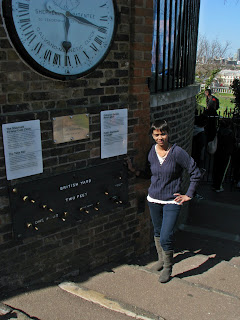
In the courtyard of the Observatory, and just outside, are brass strips set in the ground and walls marking the exact site of the line of the meridian. It is therefore possible to stand astride the line, with a foot in each hemisphere; a favourite tourist occupation.
Oops after all that excitement I looked at the watch and it was 1.30 pm and it was time for lunch and oh boy we had to climbed down that hill and find a place to eat. We find our way straight to the Greenwich market and believe me the highlight of the day’s trip to Greenwich was the visit to the market. With its colourful multi-cultural atmosphere, the market is known for some variety of good food and beer.
We decided to get back to the banks to get the cruise at 4.30. As we descended the cruise in the morning we were told that the last cruise from Greenwich was at 5.30 pm. Back on board the cruise we were once again subjected to the guides talk. Thankfully having walked so much at Greenwich we were extremely tired and I caught a short nap for 30 minutes till we were back at Westminster Pier and back to the London City.

                          The Pandemic and the Mind  Mental Health is a serious issue over the last few months. Children, young adults to Se...